Hiring an appraiser for a property tax appeal is worth considering when a New York commercial property's assessment raises a supported valuation question and the potential tax benefit justifies the assignment. An appraisal supplies independent value evidence—not a guaranteed reduction—and you must separately address filing requirements, representation, and the applicable valuation date.
- Hiring appraiser property tax appeal decisions should start with the disputed assessment, valuation date, and supporting records.
- REIS Group provides commercial real estate appraisal services; confirm the scope required for your assessment challenge.
- An appraisal addresses value; legal advice and filing responsibilities require separate agreement.
- Commission independent analysis, not a promised reduction or a predetermined property value.
Why this matters
For a Manhattan commercial property owner reviewing a 2026 assessment, the first question is not whether an appraiser can produce a lower number. It is whether credible evidence supports challenging the assessment under the applicable rules.
Order an appraisal to investigate a valuation issue, not to manufacture a tax result. Start by identifying the property interest, relevant date, disputed information, and records available. Review the commercial real estate appraisal services relevant to that assignment before requesting a proposal.
Is hiring an appraiser worth it for a property tax appeal in 2026?
Hiring an appraiser is justified when the dispute requires an independent explanation of market value rather than only correction of a factual record. For an income-producing property, that explanation can involve leases, operating expenses, vacancy, comparable transactions, and the assumptions connecting those facts to value.
The right approach depends on what is actually disputed. These options address different needs; they are not interchangeable substitutes.
| Approach | Best for | Advantage | Limitation |
|---|---|---|---|
| Factual record review | Owners identifying incorrect property information | Focuses attention on a specific, documentable discrepancy | Does not independently establish market value |
| Independent appraisal | Owners facing a substantive valuation dispute | Explains a value conclusion using property-specific evidence | Requires records, professional analysis, and an agreed scope; does not guarantee relief |
| Legal and procedural review | Owners needing advice on eligibility, deadlines, or representation | Clarifies the appeal route and responsibilities | Does not replace an appraisal when independent valuation evidence is needed |
A high tax bill alone does not establish overvaluation. Likewise, the assessed value and an appraiser's market value conclusion cannot automatically be compared as if they were the same measure. Have your adviser explain the assessment framework before treating a numerical difference as evidence of an error.
REIS Group is suited to New York commercial property owners who need an independent real estate valuation tailored to an identified intended use. Confirm that the proposed assignment addresses the requirements of your particular assessment challenge.
When an appraisal adds useful evidence
An appraisal adds substance when the disagreement concerns how the property produces income, competes in its market, or could legally and physically be used. The report should connect the evidence to the conclusion rather than simply repeat the owner's concerns.
For example, a rent roll identifies contractual income, but it does not by itself establish market rent or an appropriate capitalization rate. Capitalization converts an income measure into an indication of value; the selected income and rate both need support.
A commercial appraisal can examine whether the property's leases, expenses, condition, and market position have been analyzed appropriately. It can also address highest and best use: the reasonably probable, legally permitted use that supports the property's highest value.
The limitation is equally important. Independent analysis can support a value above, below, or consistent with the figure you questioned. Engage an appraiser only if you are prepared to receive the supported conclusion, not just your preferred conclusion.
When you should clarify the issue before commissioning a report
Pause when the concern is an unexplained increase in taxes rather than an identified valuation issue. A change in the bill does not, by itself, identify what an appraisal needs to investigate.
Also pause when the only apparent problem is a factual discrepancy, such as property information that conflicts with reliable records. Ask your adviser how that discrepancy should be raised and whether valuation evidence is necessary for the remedy being sought.
An existing appraisal deserves review before you order another. Its effective date, intended use, intended users, property rights, and reporting scope determine its relevance—not merely the fact that it concerns the same address.
For a 2026 appeal decision, do not assume that a current appraisal or an older financing report meets the proceeding's requirements. Clarifying those requirements first prevents commissioning analysis that answers the wrong question.
How should you decide whether to hire an appraiser?
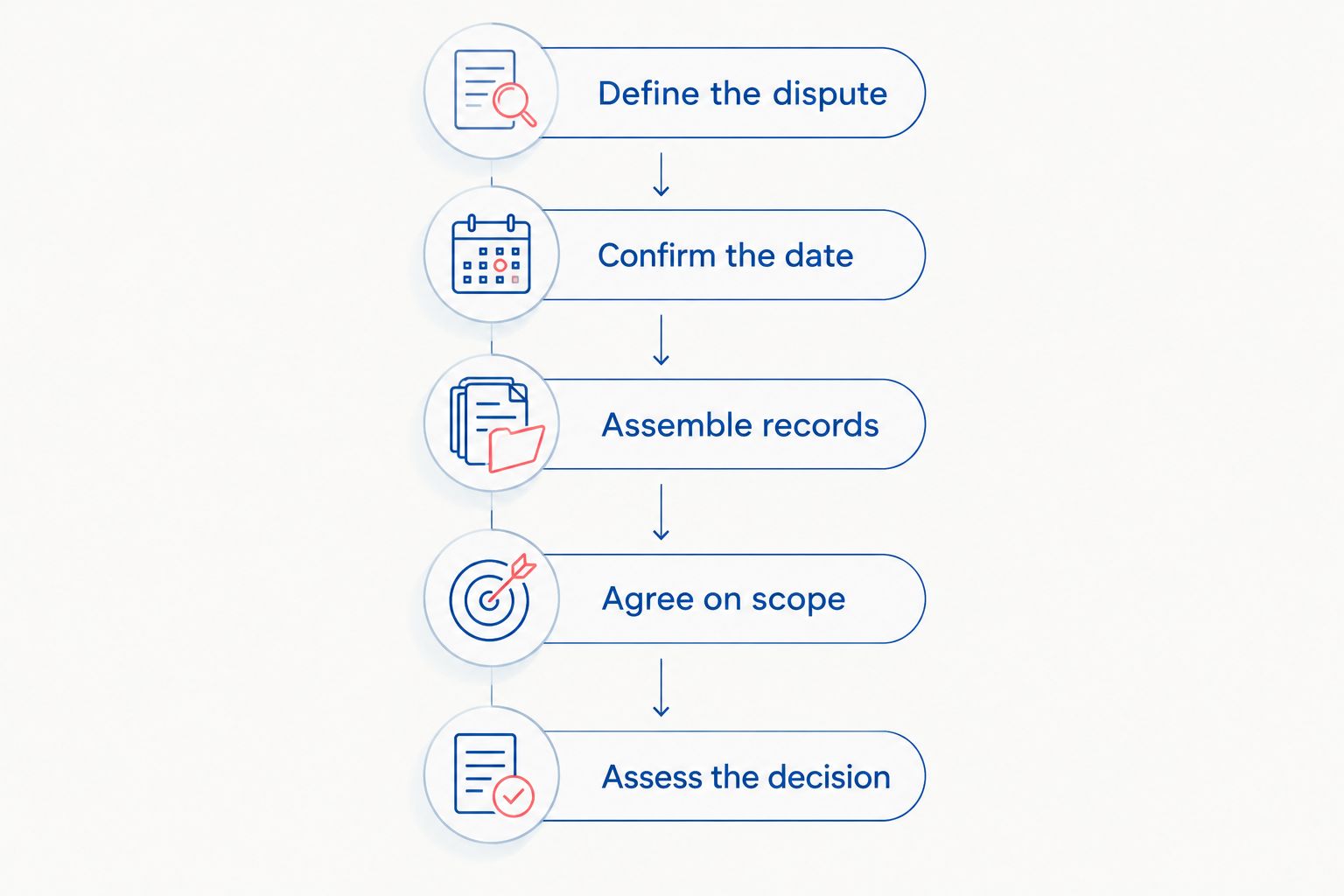
Use this sequence before authorizing a full assignment. The owner supplies records and business context; the adviser and appraiser clarify the procedural and valuation questions within their respective roles.
- Define the dispute. Identify the assessment entry or underlying assumption you question. Separate incorrect property information from disagreement about market value.
- Confirm the date. Establish the required effective date of value and applicable process with your adviser. The report preparation date and valuation date serve different purposes.
- Assemble records. Provide the assessment notice, ownership information, leases, rent roll, operating statements, and relevant condition documentation. Identify gaps rather than replacing missing records with assumptions.
- Agree on scope. Ask what analysis, inspection, reporting, and follow-up work the proposal includes. Confirm who files the challenge and who provides any required representation.
- Assess the decision. Compare the expected engagement obligations with the potential benefit identified by your adviser. Commission the assignment only when its purpose and practical use are clear.
For procedural context, review how to challenge a commercial property tax assessment in New York. Keep procedural advice separate from the appraiser's responsibility to develop and explain a value conclusion.
Why the value of hiring an appraiser varies
The usefulness of an appraisal depends on the assignment, not simply the size of the building or tax bill. These factors determine whether the analysis addresses your actual dispute:
- Nature of the dispute. Incorrect descriptive information and disagreement over investment value require different evidence. Define which problem you need to solve.
- Property type and complexity. Mixed-use, office, retail, and multifamily properties present different leasing and operating questions. Select relevant property experience.
- Effective date. A retrospective appraisal addresses a past date. Evidence must be relevant to conditions at that date, not merely conditions when the report is written.
- Records availability. Complete leases, operating statements, and condition records support clearer analysis. Missing or inconsistent information requires attention during scoping.
- Property rights appraised. Ownership subject to leases is not identical to an assumed unencumbered interest. The assignment must identify the interest being valued.
- Intended use and follow-up. A valuation report, responses to questions, and testimony are distinct responsibilities. Establish what the engagement includes before work begins.
Turnaround also depends on property type, complexity, records availability, and scope. Confirm expedited availability individually rather than assuming that an appeal deadline determines the report delivery date.
What should a commercial owner prepare?
Send an organized record package rather than an unsupported target value. For a 2026 engagement, distinguish current documents from documents relevant to the required valuation date.
Assessment and ownership records
Provide the assessment notice, property identifiers, ownership documents relevant to the interest being appraised, and any explanation of the disputed assessment. Include prior decisions or correspondence that your adviser considers relevant.
Identify the intended users of the report. An owner, attorney, and reviewing authority do not automatically have identical roles or requirements.
Income and lease records
Provide the rent roll, leases and amendments, operating statements, and explanations for unusual income or expenses. Flag concessions, vacancies, arrears, and related-party arrangements so the appraiser can evaluate their significance.
Do not substitute asking rents for executed lease terms without explanation. Both can inform analysis, but they describe different evidence.
Physical condition and use records
Supply available plans, area information, inspection material, repair documentation, and records concerning use restrictions. Explain whether a condition existed on the effective date or developed afterward.
The appraiser must evaluate how condition affects value; a repair estimate alone does not establish an equal reduction in market value. Keeping those concepts separate improves the quality of the assignment discussion.
Can you reuse an appraisal prepared for another purpose?
An existing appraisal is a starting document, not automatic evidence for a new proceeding. A financing, estate, divorce, or transaction appraisal can involve a different date, property interest, intended use, or set of assumptions.
Ask the original appraiser and your adviser whether the existing work is relevant and whether a new or revised assignment is appropriate. Do not edit the report yourself or present its conclusion without the qualifications that explain it.
For a 2026 assessment challenge, the decisive issue is whether the analysis answers the required valuation question. The same property address does not make every appraisal interchangeable.
Does a lower appraisal guarantee a lower assessment?
A lower appraisal does not guarantee a lower assessment or tax bill. The reviewing authority evaluates evidence under the applicable assessment and appeal rules, and the appraisal remains subject to questions about its methods, assumptions, and relevance.
A useful report explains why its evidence supports its conclusion. A low number without that explanation does not resolve the dispute.
What should you ask before signing an engagement?
Ask the appraiser to identify the property rights appraised, effective date, intended use, intended users, and proposed report scope. Then ask how the assignment will address the specific issue your adviser has identified.
Clarify inspection arrangements, required records, delivery expectations, and responsibility for answering later questions. If testimony or attendance at a proceeding is contemplated, discuss it expressly rather than assuming it accompanies report delivery.
REIS Group scopes commercial appraisal assignments to the property, ownership interest, valuation date, and intended use. Its independent analysis supports the identified purpose; it does not promise a preferred value, tax outcome, or acceptance by a reviewing authority.
Discuss Your Appraisal Assignment
Identify the property, assessment issue, effective date, and records available for a scoped proposal.
FAQ
Is hiring an appraiser worth it for a property tax appeal?
Hiring an appraiser is worth considering when a substantive valuation dispute requires independent evidence and the potential benefit justifies the engagement. Clarify the assessment framework, effective date, and intended use before ordering a report.
Do I need an appraisal just because my property taxes increased?
A tax increase alone does not establish that an appraisal is needed. Identify whether the concern involves property information, valuation, or another part of the assessment and tax calculation.
Can a commercial appraisal guarantee a property tax reduction?
A commercial appraisal cannot guarantee a property tax reduction. It supplies a supported value conclusion that the reviewing authority evaluates under the applicable rules.
Can I use my lender’s appraisal for an assessment appeal?
A lender’s appraisal is not automatically suitable for an assessment appeal. Have the appraiser and your adviser review its effective date, property rights, intended use, intended users, and scope.
What documents should I send a property tax appeal appraiser?
Send the assessment notice, ownership information, leases, rent roll, operating statements, and relevant condition records. Identify which documents reflect conditions at the required effective date.
Does the appraiser file my property tax appeal?
Do not assume an appraisal engagement includes filing or representation. Confirm those responsibilities separately with the appraiser and your adviser before authorizing work.
How long will an appraisal for a tax appeal take?
Appraisal turnaround depends on property type, complexity, records availability, and assignment scope. Confirm the schedule and any expedited availability individually before relying on a delivery date.
One last thing
A detailed report can still answer the wrong valuation question. Before authorizing work for a 2026 appeal, put the required effective date, property rights, and intended use beside the proposed scope and check that they match.
Bring that information, the assessment notice, and available financial records to REIS Group. Request an appraisal consultation to discuss whether a commercial valuation assignment fits the issue you need to resolve.
Related guides
- How to vet a commercial appraiser before hiring in New York
- Property tax appeal guide for commercial owners
- How long a property tax appeal takes in New York