Your divorce appraisal cost in 2026 depends on the property, ownership interest, effective date of value, and work your attorney needs; request a written, assignment-specific proposal before authorizing the appraisal. Confirm whether the proposed fee covers only the valuation report or also includes later work such as report review, deposition preparation, and testimony.
- Divorce appraisal cost depends on the assignment scope; compare written proposals for the same property rights and valuation date.
- REIS Group provides divorce real estate appraisals tailored to the property interest, effective date, and intended use.
- Ask whether litigation support and testimony are included before comparing appraisal proposals.
- For New York City property, identify cooperative, condominium, townhouse, or income-producing property requirements before requesting a proposal.
How much does a divorce appraisal cost in 2026?
Budget from a written scope, not a generic residential appraisal estimate. A divorce assignment must address the real estate question your attorney needs answered. Valuing an entire condominium at a current date is a different assignment from valuing a fractional interest in an income-producing building retrospectively.
For the engagement context, the divorce property appraisal guide for attorneys explains the assignment from counsel’s perspective. Start by separating the valuation report from any additional dispute-related services.
| Scope component | What to establish before accepting a proposal | What to clarify about the fee |
|---|---|---|
| Property appraisal | Address, property type, interest appraised, and intended use | Which property and ownership interest the proposal covers |
| Retrospective analysis | Required historical effective date and available records | What historical research the assignment requires |
| Multiple valuation dates | Each date counsel needs addressed | Whether every requested date is included |
| Report-related follow-up | Questions, corrections, or additional analysis | What falls within the original engagement |
| Litigation support | Conferences, deposition preparation, and testimony | Whether these services require separate authorization |
A proposal should identify deliverables clearly enough that your attorney can compare it with another proposal. A shorter description is not necessarily a narrower assignment, but unanswered scope questions prevent a meaningful comparison.
Why this matters
For a divorce attorney handling Manhattan or other New York City real estate in 2026, the fee question starts with the intended use. An appraisal prepared to inform settlement discussions needs an identified property interest and effective date just as an assignment involving anticipated testimony does.
The practical risk is commissioning a report before counsel has settled those instructions. A valuation can address the property accurately yet answer a different question from the one the parties need resolved.
Confirm the question before commissioning the answer. Your appraiser develops the valuation; your attorney identifies the legal purpose and advises on the instructions the case requires.
Match the proposal to the property and purpose
Different assignment types require different records and analysis. These are scope distinctions, not preset service tiers or promises about fees.
| Assignment | Best for | Useful feature | Limitation to address |
|---|---|---|---|
| Current-date residential appraisal | Counsel needing a residential value at an identified current date | Addresses the residence and its relevant market evidence | Does not establish value at a different historical date |
| Retrospective appraisal | Counsel needing value as of a past date | Relates the analysis to the required historical market | Depends on evidence of the property and market at that date |
| Income-producing property appraisal | Counsel addressing rental or commercial real estate | Examines relevant income, expenses, leases, and market evidence | Requires property records that a residence-only assignment does not |
| Partial-interest valuation | Counsel addressing a specified ownership share | Focuses on the actual interest being valued | Requires ownership analysis rather than simple percentage arithmetic |
Current-date residential appraisal
A current-date residential assignment addresses the specified property rights at its stated effective date. For a New York City cooperative apartment, condominium, or townhouse, identify the property type at the proposal stage rather than describing everything as a home appraisal.
The benefit is a defined residential valuation question. The limitation is date-specificity: a current opinion does not automatically answer what the property was worth at an earlier point in the marriage or proceeding.
Retrospective appraisal
A retrospective appraisal develops an opinion of value as of a past effective date. The inspection and report preparation can occur later, so the appraiser needs evidence that helps establish the property’s condition and circumstances at the historical date.
Historical photographs, renovation records, leases, and prior property documents can help explain changes. The limitation is evidentiary: today’s appearance alone does not establish yesterday’s condition.
Income-producing property appraisal
For a multifamily, mixed-use, retail, or office property, the engagement must address the relevant income-producing characteristics. Provide the leases, rent roll, operating information, and other records requested for the assignment.
This scope fits counsel dealing with real estate that generates income. It does not, by itself, establish the value of an operating business occupying or owning that real estate; identify any business valuation need separately.
Partial-interest valuation
A partial-interest assignment addresses a specified ownership interest rather than assuming the entire property is the asset being valued. Ownership agreements and the rights attached to that interest are relevant to defining the assignment.
A percentage ownership interest is not automatically worth the same percentage of the whole property’s value. Whether any adjustment is supported depends on the interest, evidence, and assignment; do not assume a discount applies.
Why divorce appraisal scope varies
The following factors determine what the appraiser must investigate and deliver. Establish them before comparing divorce appraisal cost proposals in 2026.
- Property type: A cooperative apartment, townhouse, and mixed-use building present different property and documentation questions.
- Property rights appraised: Whole-property ownership and a fractional interest are not interchangeable instructions.
- Effective date: A current valuation and a retrospective valuation require evidence relevant to their respective dates.
- Records availability: Missing leases, ownership documents, or historical condition evidence create questions that must be addressed in the scope.
- Complexity: Unusual property characteristics or highest-and-best-use issues require analysis suited to those facts. Highest and best use means the use that meets the applicable legal, physical, financial, and productivity tests.
- Intended use and users: Identify who will rely on the report and whether the engagement includes dispute-related work beyond its preparation.
Turnaround also depends on property type, complexity, records availability, and scope. If your attorney has a deadline, disclose it when requesting the proposal; confirm any expedited availability individually rather than assuming it.
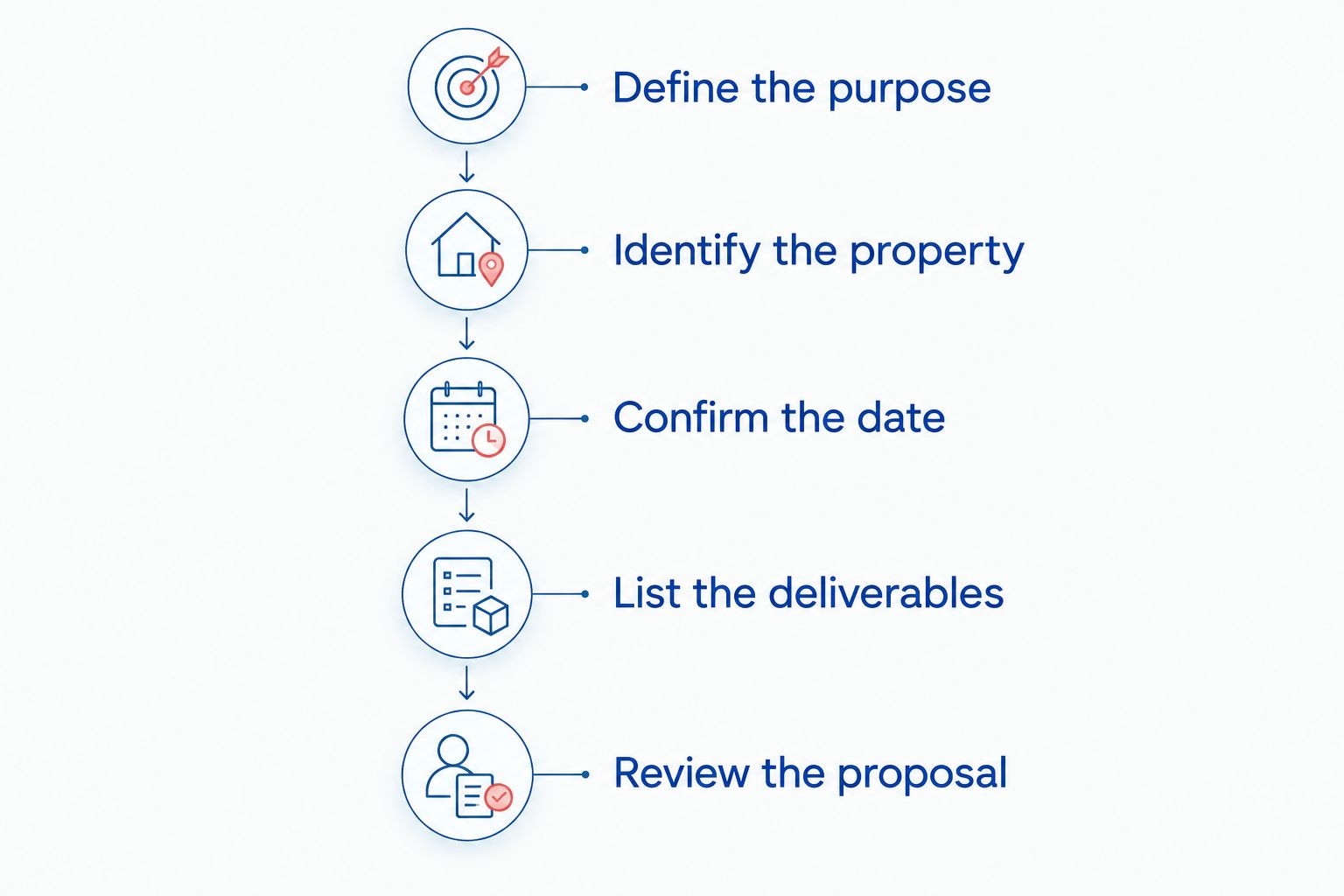
How do you request a comparable appraisal proposal?
For a 2026 engagement, send each prospective appraiser the same assignment summary. Differences in instructions make proposal comparisons less useful, even when every proposal uses the phrase divorce appraisal.
- Define the purpose. Explain whether counsel needs the valuation for settlement discussions, litigation, or another identified divorce-related use. State who is expected to rely on the report.
- Identify the property. Provide the address, property type, ownership structure, and available access information. Flag commercial space, rental units, or unusual property characteristics.
- Confirm the date. Have counsel identify the required effective date of value. Distinguish that date from the inspection date and report date.
- List the deliverables. Identify the report and any additional services under consideration. Ask how later requests for analysis or testimony will be authorized.
- Review the proposal. Check that the written engagement reflects the agreed instructions, records requirements, timing, and fee terms before work begins.
Documents to assemble before requesting the proposal
Send what you have and identify what remains unavailable. This is a starting checklist; the appraiser determines the records needed for the actual assignment.
- Property address and a description of the real estate being valued.
- Deed, ownership statement, or documents identifying the interest at issue.
- Counsel’s instructions concerning the effective date and intended use.
- Floor plans, surveys, prior appraisals, and relevant property records, if available.
- Photographs and renovation records relevant to current or historical condition.
- Leases, rent rolls, and operating records for income-producing property.
- Known access restrictions and the case deadline requiring consideration.
Do not delay the initial scope discussion merely because the file is incomplete. Explain the gaps so the appraiser can identify which records matter to the proposed work.
Does a divorce appraisal fee include testimony?
Do not assume a report proposal includes testimony. Ask whether conferences with counsel, deposition preparation, deposition attendance, and court testimony are included, excluded, or subject to separate engagement terms.
This distinction matters even when the parties hope to settle. Ask how additional services would be arranged if the case later requires them; do not commission litigation work solely because it appears on a list of possibilities.
Can an existing appraisal reduce the work required?
An existing appraisal can provide background, but its suitability depends on its effective date, property rights, intended use, and underlying evidence. Give it to counsel and the appraiser for assessment rather than assuming it replaces the requested divorce appraisal.
A prior lending appraisal, for example, was prepared for its own identified purpose and users. Neither its existence nor its conclusion establishes that it answers the current assignment, and no fee reduction should be assumed before review.
Should both parties use the same appraiser?
A jointly instructed appraiser can address a shared valuation question when the parties and their attorneys agree on the engagement. The advantage is a common set of instructions; the limitation is that agreement on an appraiser does not resolve every legal or valuation dispute.
Separate engagements allow each party to obtain an independently instructed opinion, but reports still need comparable dates and property rights for a useful discussion. Counsel should decide the engagement structure rather than selecting it solely on anticipated expense.
Choosing the right scope with REIS Group
REIS Group provides divorce real estate appraisals for attorneys and property owners who need reports tailored to a defined valuation purpose. Its principal market is Manhattan and the greater New York City area, with nationwide assignments coordinated through its professional network.
REIS Group brings over 30 years of experience to real estate appraisal and valuation consulting. The firm’s work includes residential, commercial, and partial-interest valuations, allowing the scope discussion to focus on the actual real estate interest involved.
A purpose-specific report provides a supported valuation conclusion, not a guarantee of settlement or acceptance by a court or another party. For a 2026 proposal, identify the property, effective date, ownership interest, intended users, and anticipated dispute-related services.
Discuss Your Appraisal Assignment
Share the property, ownership interest, valuation date, and intended use to discuss an appropriate scope.
FAQ
How do I find out my divorce appraisal cost?
Request a written proposal identifying the property, ownership interest, effective date, intended use, and deliverables. Compare proposals only after confirming that they address the same assignment.
Is a divorce appraisal the same as a mortgage appraisal?
A divorce appraisal and a mortgage appraisal serve different identified purposes. An existing mortgage appraisal needs assessment for its date, property rights, intended use, and suitability before counsel relies on it for a divorce matter.
Does the appraisal fee include court testimony?
Court testimony is included only if the engagement terms say so. Confirm the treatment of preparation, conferences, deposition attendance, and testimony before accepting the proposal.
Can an appraiser value my property as of a past date?
A retrospective appraisal addresses value as of a past effective date. The appraiser needs evidence relevant to the property’s condition and market at that date, even when the inspection occurs later.
What documents should my divorce attorney provide?
Your divorce attorney should provide the assignment purpose, required valuation date, property interest, intended users, and relevant deadlines. Ownership records, historical condition evidence, and income records also help define the work where applicable.
Can one appraisal cover my property and the business inside it?
Real estate appraisal and operating-business valuation address different assets and require clearly defined scopes. Tell the appraiser and counsel whether the assignment concerns the property, the business, an ownership interest, or separate valuation questions.
Does a divorce appraisal guarantee the court will accept the value?
A divorce appraisal does not guarantee court acceptance or a particular outcome. Its role is to provide a supported opinion for the identified property interest, effective date, and intended use.
One last thing
Check the effective date before comparing fees. A report delivered in 2026 can address an earlier effective date, and a recent inspection does not change the date the valuation must answer.
For a focused proposal discussion with REIS Group, bring counsel’s valuation instructions along with the property information. Discuss your appraisal assignment before authorizing work so the report addresses the question your case requires.
Related guides
- Residential appraisal services for divorce cases
- Commercial appraisal guide for property investors
- Business valuation guide for CPAs and accountants