

For CPAs handling New York City estates, choose an appraisal service by the valuation date, property type, and ownership interest—not a generic firm ranking. REIS Group provides estate appraisal services for CPAs who need real estate valuations tailored to estate reporting and administration; start by defining the assignment before requesting a proposal.
- REIS Group provides estate appraisal services for CPAs handling New York City real estate and estate-tax reporting.
- Choose date-of-death appraisal services when the assignment requires real estate value as of the decedent’s death.
- Separate whole-property appraisal from partial-interest valuation; they answer different questions.
- Confirm intended use, ownership interest, effective date, and supporting records before engaging an appraiser.
Why the appraisal assignment matters
An estate’s real estate value is not simply today’s likely selling price. Your assignment needs a defined effective date, identified property rights, and analysis that supports the intended use.
For a 2026 estate engagement, begin with the date-of-death appraisal to Form 706 workflow. Coordinate the reporting purpose with estate counsel before commissioning the report; a later request for a different date or ownership interest changes the valuation question.
The right service answers the estate’s actual valuation question, not merely what the building would sell for today. That distinction guides the service choices below.
What makes an estate appraisal service suitable for CPAs?
Evaluate the proposed assignment against these criteria before comparing providers:
- Purpose alignment: The engagement identifies the estate-reporting or administration need and the report’s intended users.
- Effective-date clarity: The appraiser distinguishes the date being valued from the inspection and report dates.
- Property competence: Relevant experience matches the asset, whether a Manhattan cooperative apartment, townhouse, or income-producing building.
- Ownership analysis: The scope identifies whether the assignment concerns the entire property, a direct fractional interest, or a different ownership structure.
- Supportable conclusions: The report explains relevant evidence, assumptions, methods, and reasoning rather than presenting an unexplained value.
- Practical coordination: The proposal addresses document requirements, access, scope, and timing without promising a predetermined result.
REIS Group has over 30 years of experience and serves attorneys, CPAs, fiduciaries, and property owners. Its principal market is Manhattan and greater New York City, with nationwide assignments coordinated through its professional network.
Estate appraisal services at a glance
These are service categories, not competing firm endorsements. A single engagement can combine several categories—for example, a retrospective appraisal of an income-producing building.
| Service | Best for | Main focus | Key limitation |
|---|---|---|---|
| Date-of-death real estate appraisal | Initial estate reporting | Value as of the decedent’s death | Does not automatically address another date or interest |
| Retrospective appraisal | Earlier valuation dates investigated later | Historical property and market evidence | Depends on the support available for past conditions |
| Residential estate appraisal | Estates holding apartments or houses | Property-specific residential analysis | Does not resolve a separate fractional-interest question |
| Commercial estate appraisal | Estates holding income-producing real estate | Leases, income, expenses, and market evidence | Requires records appropriate to the effective date |
| Partial-interest valuation | Estates holding less than the entire interest | Rights and restrictions of the interest appraised | Requires more than multiplying whole-property value by ownership percentage |
1. Date-of-death appraisal: for initial estate reporting
Best for: CPAs establishing the real estate valuation assignment after a death.
A date-of-death appraisal develops an opinion of value as of the decedent’s death. The report can be prepared afterward; the effective date identifies when the value applies, not when the appraiser signs the report.
For a death occurring in 2026, specify the actual date rather than asking for a general 2026 valuation. The CPA and estate attorney should confirm the reporting purpose, applicable valuation instructions, and interest to be appraised.
Date-of-death appraisal advantages:
- Establishes a specific historical valuation question.
- Connects property analysis to the estate’s identified reporting purpose.
- Provides a documented basis for professional review.
Date-of-death appraisal limitations:
- Does not establish that the same report suits every subsequent transaction or filing.
- Requires investigation of conditions at the effective date, including changes made afterward.
Ask whether the proposal identifies the property rights, intended users, and assumptions. Avoid an engagement described only as an estate appraisal without those details.
Verdict: Choose date-of-death appraisal when the estate needs real estate value as of death.
2. Retrospective appraisal: for reconstructing an earlier value
Best for: CPAs addressing an earlier effective date after time has passed.
A retrospective appraisal values property as of a past date. Date-of-death appraisal is one application, but retrospective work can also address another historical date identified by the client and professional advisers.
The distinguishing issue is evidence. Historical photographs, leases, repair records, and earlier property descriptions help separate past conditions from what an inspection reveals today.
Retrospective appraisal advantages:
- Addresses a past valuation date rather than substituting current value.
- Gives historical records a defined role in the analysis.
- Explains the assumptions used to reconstruct earlier conditions.
Retrospective appraisal limitations:
- Missing records restrict what the appraiser can substantiate.
- A current inspection alone does not establish the property’s earlier condition.
If you commission the assignment in 2026 for an earlier effective date, identify intervening renovations, lease changes, casualty damage, or changes in use. Supply the relevant dates and records without assuming current conditions existed throughout.
Verdict: Choose retrospective appraisal when establishing past conditions is central to the assignment.
3. Residential estate appraisal: for apartments and houses
Best for: CPAs handling estates with cooperative apartments, condominiums, townhouses, or one- to four-family properties.
Residential estate appraisal examines the specific property and relevant market evidence at the required effective date. Property type matters: a cooperative apartment presents a different ownership and document context from a townhouse.
A useful engagement identifies occupancy, condition, renovations, and any relevant property restrictions. An address and an online estimate do not explain those facts.
Residential estate appraisal advantages:
- Focuses the analysis on the relevant residential property type.
- Addresses condition and features that broad neighborhood figures omit.
- Supports a defined estate purpose rather than a general asking-price discussion.
Residential estate appraisal limitations:
- Access and incomplete condition records can complicate the scope.
- A whole-property conclusion does not itself value a separate partial interest.
Send the appraiser available floor plans, ownership documents, renovation information, and relevant building records. For occupied property, identify who can arrange access and who can explain conditions at the effective date.
Verdict: Choose residential estate appraisal when the asset’s residential characteristics drive the valuation.
4. Commercial estate appraisal: for income-producing property
Best for: CPAs handling estates with multifamily, mixed-use, retail, office, or other income-producing real estate.
Commercial estate appraisal examines the property alongside its income characteristics and market context. Leases, occupancy, operating expenses, and property condition are central inputs—not administrative attachments.
Distinguish real estate from an operating business housed in the building. Ownership of both does not make their valuation questions interchangeable, and separate scopes need coordination.
Commercial estate appraisal advantages:
- Examines property income and expenses in their market context.
- Addresses lease terms and occupancy relevant to the effective date.
- Supports analysis of the property’s highest and best use—the use that meets the applicable legal, physical, financial, and productivity tests.
Commercial estate appraisal limitations:
- Incomplete rent rolls or inconsistent operating records require clarification.
- Appraising business-owned real estate does not establish the operating business’s value.
For a 2026 engagement, label every rent roll and operating statement by its applicable period. Current records and historical records serve different purposes; do not combine them without explanation.
Verdict: Choose commercial estate appraisal when leases, operations, and investment characteristics require property-specific analysis.
5. Partial-interest valuation: for fractional ownership
Best for: CPAs handling an estate’s fractional real estate interest.
A partial-interest valuation addresses the specified interest rather than assuming the estate owns the entire property. The analysis depends on the rights, restrictions, and ownership structure relevant to that interest.
A whole-property appraisal can be an input, but applying an ownership percentage does not necessarily complete the assignment. Distinguish direct real estate ownership from an interest in an entity that owns real estate.
Partial-interest valuation advantages:
- Identifies the actual ownership interest under consideration.
- Examines relevant rights and restrictions rather than percentage alone.
- Clarifies how property-level evidence relates to the interest being valued.
Partial-interest valuation limitations:
- Requires ownership and governing documents appropriate to the structure.
- Does not justify an automatic discount or predetermined adjustment.
REIS Group provides partial-interest valuations within an assignment-specific scope. Review the partial-interest appraisal scoping considerations before assembling documents and requesting a proposal.
Verdict: Choose partial-interest valuation when the estate’s ownership interest differs from ownership of the entire property.
Prepare an engagement package before requesting a proposal
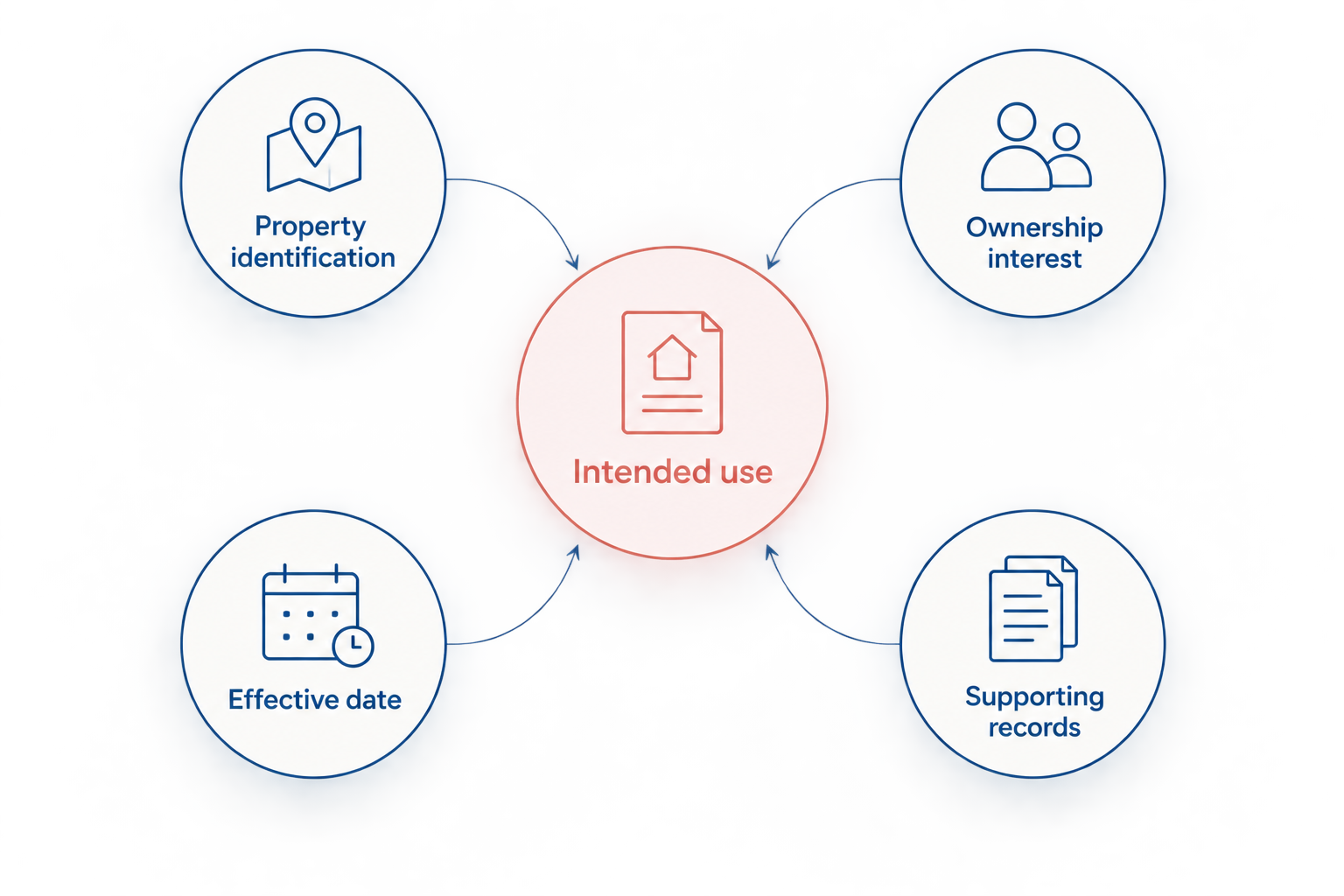
A concise intake package makes the valuation question clear. Organize these 5 assignment details before contacting an appraiser:
- Intended use: State the estate-reporting or administration purpose and identify the intended users.
- Property identification: Provide the address, property type, available ownership records, and access contact.
- Ownership interest: Explain what the decedent owned and include relevant governing documents.
- Effective date: Specify the date to be valued and flag later changes to the property.
- Supporting records: Supply available condition evidence, leases, operating records, and prior reports relevant to the assignment.
Keep 3 dates separate in your instructions: the effective date of value, the inspection date, and the report date. They describe different events and are not interchangeable.
Ask the proposed appraiser to identify unresolved scope questions before engagement. Turnaround depends on property type, complexity, records availability, and scope; expedited availability requires individual confirmation.
Discuss Your Appraisal Assignment
Share the property, ownership interest, effective date, and intended use to discuss the appropriate scope.
How to use this comparison
The service categories above are organized by assignment need: reporting date, historical evidence, property type, and ownership interest. They are not independent quality scores or claims that one category replaces another.
Use the criteria to review a proposal, not to seek a preferred value. A suitable engagement explains what the appraiser will analyze and what the report is intended to support.
Which service should your estate engagement use?
Start with date-of-death appraisal when the reporting question concerns real estate value at death, then add the property and ownership scope the assignment requires. A commercial building held fractionally needs both property-level and ownership-interest questions resolved.
REIS Group provides estate appraisal services for CPAs handling Manhattan and greater New York City properties, with nationwide coordination available through its professional network. Discuss the asset, date, and reporting purpose before choosing the scope.
FAQ
What estate appraisal service should a CPA request first?
Request a scope tied to the estate’s intended use, effective date, property type, and ownership interest. A date-of-death appraisal is the appropriate starting point when the question is real estate value as of the decedent’s death.
Is a date-of-death appraisal the same as a retrospective appraisal?
A date-of-death appraisal is a retrospective appraisal when it is prepared after the death. Retrospective describes a past effective date; date-of-death identifies the particular date being valued.
Can a CPA use a current appraisal for an earlier death?
A current-value conclusion does not answer an earlier date-of-death valuation question. Ask the appraiser to address the required historical effective date and supporting evidence.
Does an estate need separate residential and commercial appraisals?
The scope must address each property’s characteristics and the assignment’s intended use. Discuss the estate’s property list with the appraiser rather than assuming one analysis covers unlike assets.
Can a CPA calculate a fractional interest from whole-property value?
Multiplying whole-property value by the ownership percentage does not necessarily establish the partial interest’s value. The relevant ownership rights, restrictions, and structure require consideration.
What affects estate appraisal timing?
Property type, complexity, records availability, access, and scope affect timing. Confirm the proposed schedule for the specific assignment and ask separately about expedited availability.
Does an estate appraisal guarantee acceptance by the IRS?
No estate appraisal guarantees IRS acceptance or a particular tax outcome. The report should support the identified valuation purpose with clearly explained evidence, methods, and conclusions.
One last thing
The report date is not the value date. Before submitting a 2026 engagement request, put the requested effective date in the opening instructions—not only in an attachment.
Request an appraisal proposal that identifies the property, ownership interest, intended use, and effective date. That gives your appraisal consultation a specific question to resolve.
Related guides
- Date-of-death appraisal guidance for New York executors and attorneys
- Can one appraisal support estate-tax and probate filings?
- How to obtain a retrospective appraisal for inherited property