To provide the best experiences, we use technologies like cookies to store and/or access device information. Consenting to these technologies will allow us to process data such as browsing behavior or unique IDs on this site. Not consenting or withdrawing consent, may adversely affect certain features and functions.
The technical storage or access is strictly necessary for the legitimate purpose of enabling the use of a specific service explicitly requested by the subscriber or user, or for the sole purpose of carrying out the transmission of a communication over an electronic communications network.
The technical storage or access is necessary for the legitimate purpose of storing preferences that are not requested by the subscriber or user.
The technical storage or access that is used exclusively for statistical purposes.
The technical storage or access that is used exclusively for anonymous statistical purposes. Without a subpoena, voluntary compliance on the part of your Internet Service Provider, or additional records from a third party, information stored or retrieved for this purpose alone cannot usually be used to identify you.
The technical storage or access is required to create user profiles to send advertising, or to track the user on a website or across several websites for similar marketing purposes.
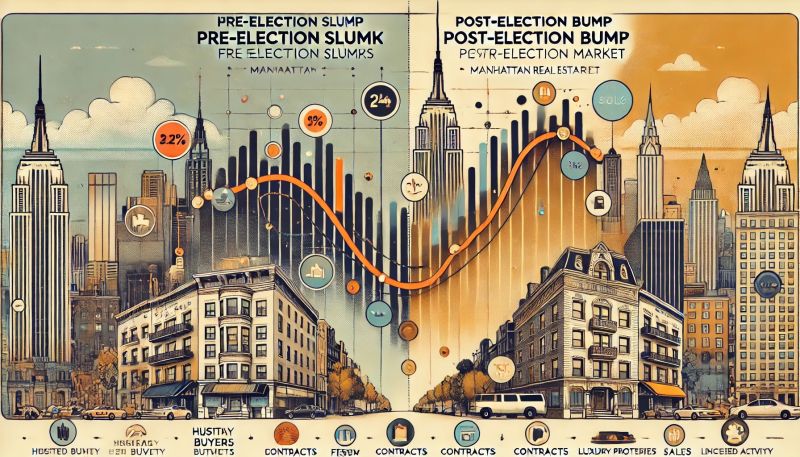











Pre-Election Slump
1. Uncertainty and Hesitation:
• Buyers and sellers typically hold off on major decisions in the months leading up to an election. Uncertainty about political, tax, and economic policies can lead to reduced activity.
• For example, in the months preceding the 2020 and 2016 elections, Manhattan saw declining contract signings and slower price growth.
2. Luxury Market Sensitivity:
• High-net-worth individuals in the luxury segment are particularly cautious. Speculation over changes in tax codes, capital gains laws, or real estate regulations often results in a slowdown in luxury sales before elections.
• In 2024, luxury real estate activity dropped significantly during the summer and early fall, reflecting this typical pre-election pattern.
Post-Election Bump
1. Renewed Confidence:
• Once election results are clear, confidence often returns to the market, especially if the policies of the incoming administration align with market-friendly expectations.
• For instance, after the 2016 election, Manhattan’s luxury market saw a surge in activity, with several high-profile deals closing within weeks.
2. Wealth Redistribution and Investment Adjustments:
• Many investors and foreign buyers re-enter the market after elections, particularly in cities like Manhattan, where real estate is considered a safe asset.
• Following the 2024 election, the luxury market experienced a 20-30% increase in contract signings in November, signaling renewed interest from affluent buyers.
3. Tax and Policy Impacts:
• Policies introduced by the new administration—such as changes to SALT deductions or property tax laws—can directly impact buyer behavior. After the 2018 tax reform under the Trump administration, Manhattan’s real estate market faced headwinds due to capped state and local tax (SALT) deductions.
Key Examples of Post-Election Activity
• 2012: President Obama’s reelection led to a boost in mid-market properties due to policies favorable to middle-class buyers.
• 2016: Trump’s election initially triggered a luxury market bump, as investors anticipated a business-friendly environment.
• 2020: Biden’s victory led to a modest uptick in transactions, with buyers expecting stability and fiscal stimulus policies.
After the 2024 U.S. presidential election, Manhattan experienced:
• A 46% surge in contract signings compared to the previous month.
• Stabilization in mid-tier markets, though inventory remained constrained.
In summary, the Manhattan real estate market consistently reflects these pre- and post-election cycles, underscoring the interplay between politics, buyer confidence, and market dynamics.