

REIS Group provides divorce appraisals for New York City attorneys and property owners who need real estate values tied to a defined ownership interest, valuation date, and intended use. For a 2026 assignment, start by matching the appraisal scope to the property and the question counsel needs answered—not by choosing a firm from an unsupported ranking. REIS Group serves Manhattan and the greater New York City area.
- REIS Group provides divorce appraisal services for New York City attorneys and property owners needing purpose-specific real estate valuations.
- For a divorce appraisal New York City assignment, define the property rights, effective date, and intended use first.
- Choose residential, retrospective, commercial, or partial-interest analysis according to the assignment—not the desired settlement result.
- Request a proposal that separates the appraisal report from any additional litigation-related services.
Why this matters
A divorce appraisal answers a valuation question. It does not decide how spouses should divide property, determine legal ownership, or establish the amount of a settlement. Your attorney handles those legal questions; the appraiser develops a supported opinion of value within the agreed scope.
A report prepared in 2026 does not necessarily measure value in 2026. The effective date of value is the date the valuation addresses, while the report date identifies when the report was completed. Confusing those dates can produce a report that answers the wrong question.
For counsel organizing the engagement, the divorce property appraisal guide for attorneys provides a related starting point. Before requesting a proposal, identify the property, relevant ownership documents, requested date, and intended users.
What makes a suitable NYC divorce appraisal service?
Evaluate the assignment fit before comparing proposals. These criteria matter more than a generic claim that a provider is “best.”
- Property experience: Ask about work involving the relevant property type, such as cooperative apartments, condominiums, townhouses, or income-producing buildings.
- Defined valuation question: Specify the property rights appraised, effective date, intended use, and intended users before work begins.
- Supported analysis: Look for an explanation of the evidence, methods, assumptions, and reasoning behind the conclusion—not just a final figure.
- Historical evidence: For a retrospective assignment, ask how the appraiser will investigate the property's condition and market circumstances at the earlier date.
- Clear engagement boundaries: Confirm whether the proposal covers only the report or also includes conferences, responses to questions, or other requested services.
- Independence: Select an appraiser to analyze the evidence, not to reach a value that favors either spouse.
The most suitable service is the one that answers counsel's actual valuation question. A detailed report about the wrong ownership interest or date does not solve the assignment.
Divorce appraisal options at a glance
The following order starts with a residential assignment and then addresses distinct complexities. It compares service scopes, not independently verified rankings of competing firms. More than one scope can apply to the same property.
| Service scope | Best for | Defining analysis | Key limitation |
|---|---|---|---|
| REIS Group residential divorce appraisal | A residence requiring a defined-date value | Property-specific residential analysis | Does not determine the legal division of equity |
| Retrospective real estate appraisal | A value needed as of an earlier date | Historical property and market evidence | Depends on support for historical facts and assumptions |
| Commercial real estate appraisal | Rental buildings and other income-producing property | Income, expenses, leases, and market evidence | Property value is not an operating-business valuation |
| Partial-interest real estate appraisal | A defined fractional ownership interest | Rights, restrictions, and characteristics of that interest | Is not automatically a percentage of whole-property value |
1. REIS Group: residential divorce appraisal
Best for: Attorneys and spouses needing a defined-date value for a NYC residence.
REIS Group provides residential and divorce-related real estate appraisal services, with over 30 years of experience. Its residential scope includes cooperative apartments, condominiums, townhouses, and 1- to 4-family properties. The engagement should identify the particular property rights and valuation purpose rather than assume every residential report serves the same use.
For a cooperative apartment, provide the ownership and building information relevant to the assignment. For a condominium or townhouse, identify alterations, condition issues, and available property records. The appraiser determines which additional documents and inspection arrangements the analysis requires.
Residential appraisal advantages:
- Focuses the analysis on the residence and its relevant market evidence.
- Connects the conclusion to an identified effective date.
- Provides a written basis for discussing the property's value with counsel.
Residential appraisal limitations:
- An appraised property value is not a calculation of the spouses' respective entitlements.
- A report scoped for one purpose is not automatically suitable for another use or user.
Verdict: Request a residential appraisal proposal when the disputed asset is a residence and counsel has defined the valuation date. Identify any historical-date requirement at the outset; that changes the evidence needed.
2. Retrospective appraisal: an earlier valuation date
Best for: Divorce matters requiring real estate value as of a past date.
A retrospective appraisal develops an opinion of value for an effective date before the report is prepared. For an engagement commissioned in 2026, the attorney should identify the required date rather than leave the appraiser to infer it from the dispute.
The central issue is evidence. Renovations, damage, occupancy changes, and lease changes after the effective date must be distinguished from circumstances relevant to that date. A current inspection alone does not establish every historical property condition.
Retrospective appraisal advantages:
- Addresses the date specified for the assignment.
- Separates historical conditions from subsequent changes.
- Makes the treatment of historical evidence and assumptions explicit.
Retrospective appraisal limitations:
- Missing records can limit support for historical property conditions.
- Present-day photographs and owner recollections require careful evaluation rather than automatic acceptance.
Gather dated photographs, renovation records, prior reports, leases, and other relevant documents before the engagement discussion. Do not discard a document simply because it records a condition that no longer exists.
Verdict: Request a retrospective scope when the required value concerns an earlier date; do not substitute today's value. Counsel should confirm which date or dates the assignment must address.
3. Commercial appraisal: income-producing property
Best for: Divorce matters involving multifamily, mixed-use, retail, office, or other income-producing real estate.
A commercial appraisal examines the property and the evidence relevant to its earning capacity, market position, and ownership rights. Lease terms, operating expenses, vacancy, physical condition, and legally relevant restrictions can affect the analysis. A building's gross rent alone is not a supported value conclusion.
Provide rent rolls, leases, operating statements, and available capital-improvement records. Explain unusual items rather than silently removing them from the materials supplied. The appraiser decides how those facts affect the valuation; counsel determines their relevance to the legal dispute.
Commercial appraisal advantages:
- Addresses income-producing real estate as an investment asset.
- Examines lease and operating information alongside market evidence.
- Can distinguish property-level facts from unsupported owner expectations.
Commercial appraisal limitations:
- Incomplete financial or lease records require resolution or explicit treatment in the analysis.
- Valuing a building occupied by a business does not establish the value of that operating business.
For a 2026 engagement involving business-owned property, identify whether counsel needs the real estate, an entity interest, the operating business, or separate analyses. Those are different valuation questions, even when they concern the same address.
Verdict: Request a commercial scope for income-producing real estate, and define any separate business-valuation need before engagement.
4. Partial-interest appraisal: fractional ownership
Best for: A divorce assignment focused on a specified fractional real estate interest.
A partial-interest appraisal addresses an identified ownership interest rather than assuming the entire property is the asset under review. The appraiser needs the relevant ownership documents and a clear description of the interest. Counsel should clarify legal rights and disputed interpretations.
An interest's rights, restrictions, transfer provisions, and control characteristics require analysis. Do not assume that an ownership percentage multiplied by the whole-property value answers the question. Equally, do not assume that every fractional interest warrants a valuation discount.
Partial-interest appraisal advantages:
- Directs the analysis toward the actual interest being valued.
- Identifies ownership provisions relevant to the assignment.
- Distinguishes whole-property value from an interest-level conclusion.
Partial-interest appraisal limitations:
- The scope depends on clear ownership information and the relevant legal framework.
- A real estate interest and an ownership interest in a property-holding entity are not interchangeable assignments.
Verdict: Request a partial-interest consultation when the identified asset is less than the whole property. Resolve the nature of the ownership interest before selecting the valuation scope.
Prepare an attorney-led appraisal request
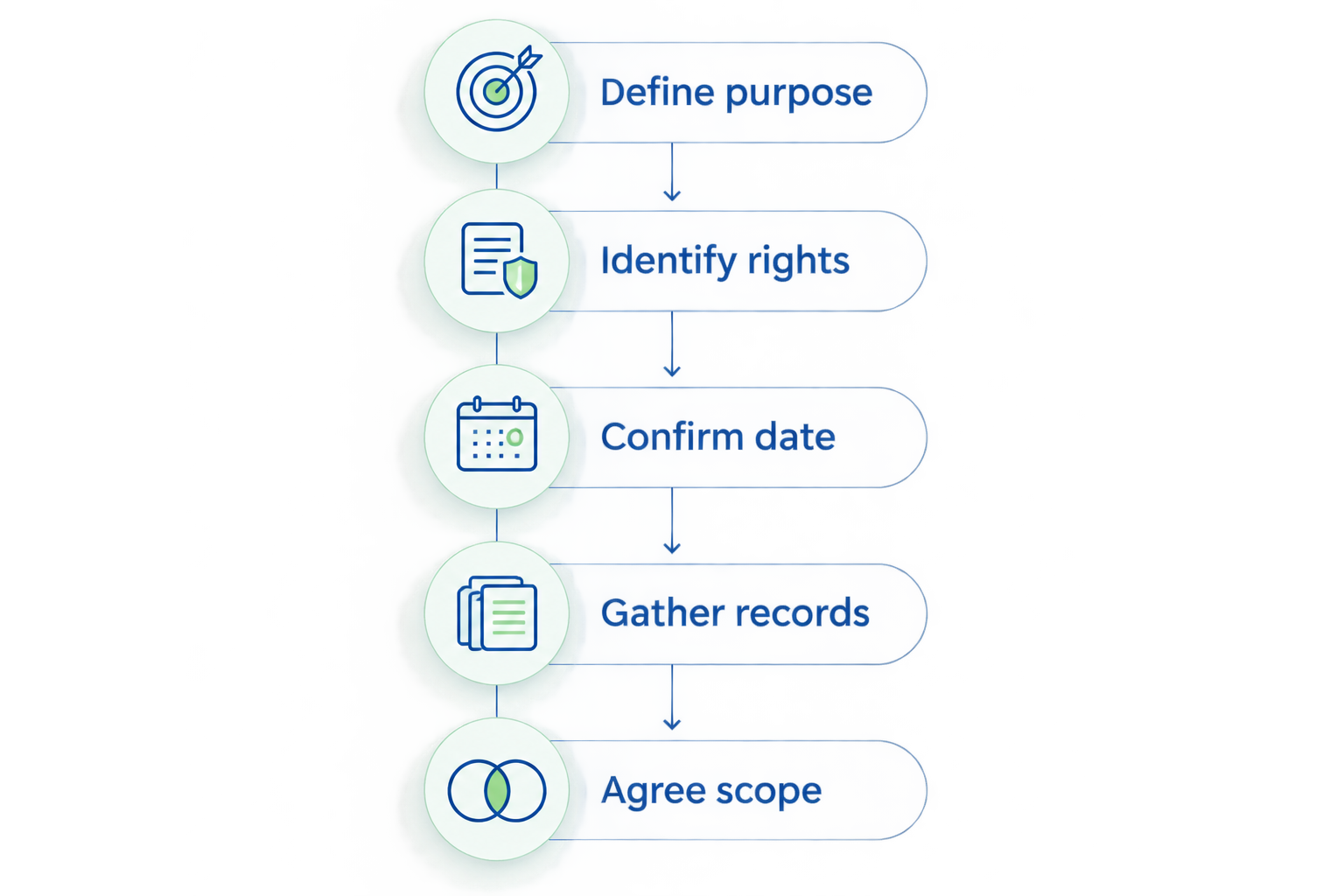
Give the appraiser a clear assignment description before discussing scheduling. A useful 2026 engagement request covers the following steps in order.
- Define purpose: Explain whether the report will support negotiations, litigation preparation, or another identified use.
- Identify rights: Supply the property address and describe the ownership interest counsel needs valued.
- Confirm date: State the requested effective date or flag that counsel must still determine it.
- Gather records: Assemble available ownership, condition, lease, financial, and historical materials relevant to the property.
- Agree scope: Confirm intended users, inspection arrangements, report requirements, and any additional requested services.
If access is disputed or records are incomplete, explain that before accepting a proposal. The engagement should address the practical limits of the available evidence rather than discover them after work begins.
Turnaround depends on property type, complexity, records availability, and scope. Ask for a schedule based on the actual assignment; expedited availability must be confirmed individually. A requested court or negotiation date is useful planning information, not an automatic delivery commitment.
Discuss Your Appraisal Assignment
Identify the property, ownership interest, effective date, and intended use for a tailored proposal.
How these recommendations are organized
These recommendations follow the property experience, defined-date analysis, evidence, and engagement boundaries described above. Residential appraisal comes first as the starting scope for a residence; retrospective, commercial, and partial-interest services address different assignment requirements.
REIS Group's stated services support its inclusion here. The recommendations do not claim that the firm outranks other providers, guarantees a legal outcome, or produces reports immune to challenge.
Which divorce appraisal scope should you choose?
For a NYC residence, start with a residential appraisal consultation and tell the appraiser immediately if counsel needs a historical date. Choose commercial analysis for income-producing property and discuss partial-interest analysis when the identified asset is a fractional interest.
Do not commission separate reports merely because several categories apply. A commercial property can require a retrospective effective date, and a residential property can involve fractional ownership. Ask for a coordinated scope that addresses the actual questions without unnecessary duplication.
FAQ
What’s the right divorce appraisal service for a New York City apartment?
Choose a residential appraisal scoped to the apartment, ownership interest, effective date, and intended use. Identify whether the property is a cooperative or condominium and provide the relevant ownership and building records.
Does a divorce appraisal tell us how to divide the property’s equity?
No. A real estate appraisal provides an opinion of value for the defined assignment; it does not determine either spouse’s legal entitlement. Your attorney addresses ownership, liabilities, and equitable-distribution questions.
Can a divorce appraisal value property as of an earlier date?
Yes. A retrospective appraisal addresses an effective date before the report is prepared. Historical records help the appraiser evaluate property conditions and market evidence relevant to that date.
Can one spouse order an appraisal alone?
Discuss the proposed engagement with counsel before ordering. Authority, property access, intended users, and any applicable case instructions need to be addressed in the assignment scope.
Does a divorce appraisal guarantee court acceptance?
No appraisal guarantees acceptance by a court or another party. Counsel should identify the intended litigation use and discuss report requirements and any additional services before engagement.
How long does a New York City divorce appraisal take?
Timing depends on property type, complexity, records availability, and scope. Request an assignment-specific schedule, and confirm any expedited availability individually.
Can the same assignment include real estate and a family business?
Real estate appraisal and operating-business valuation are distinct analyses. Identify each asset and intended use so the required services and professional responsibilities can be scoped separately.
One last thing
Check the effective date before checking the value conclusion. A carefully supported report can still miss your assignment's purpose if it values the wrong rights or addresses the wrong date.
For a 2026 divorce appraisal, bring REIS Group the property address, ownership information, counsel's valuation question, and available records. Discuss Your Appraisal Assignment and request a proposal tailored to that purpose.
Related guides
- Can a divorce appraisal be ordered by one spouse alone?
- How long does a divorce appraisal take?
- How to appraise a partial ownership interest in real estate