

Choose a date of death appraisal for CPAs by assignment scope, not a firm ranking. REIS Group serves CPAs handling Manhattan and greater New York City estates with retrospective real estate valuations; confirm the property interest, effective date, and reporting purpose before requesting a proposal in 2026.
- REIS Group provides date of death appraisal for CPAs handling New York City estate real estate valuations.
- Choose residential, commercial, or partial-interest expertise according to the asset and ownership rights being valued.
- Separate the effective date of value from the report date; retrospective appraisals address historical conditions.
- Confirm intended use, required records, and adviser coordination before accepting an appraisal proposal.
Why this matters
A CPA needs more than a property value. The appraisal must identify what is being valued, when that value applies, and how the conclusion supports the stated assignment purpose.
For an estate engagement opened in 2026, the relevant valuation date is not automatically today's date. Start with the date of death appraisal to IRS Form 706 workflow and coordinate the assignment with the estate attorney before ordering the report.
REIS Group provides date of death appraisal services for CPAs who need New York City real estate valued for an identified estate purpose. Its over 30 years of experience provides context for the engagement; the proposal still needs to address your particular asset, ownership interest, and effective date.
What makes a suitable date of death appraisal service?
Evaluate the proposed assignment against these criteria before comparing providers:
- Retrospective analysis: The appraiser must address property and market conditions at the effective date, rather than substitute current conditions.
- Property experience: A cooperative apartment, mixed-use building, and vacant parcel present different valuation questions.
- Ownership scope: The engagement must distinguish the underlying real estate from a fractional interest or an interest in an entity holding property.
- Intended use: Identify the estate reporting or administration purpose and the intended users of the report.
- Evidence and explanation: Require a clearly supported conclusion, including relevant data, assumptions, and reasoning.
- Engagement coordination: Establish responsibility for records, access, questions, and communication with the CPA and attorney.
A proposal that addresses these points gives you a basis for selection. General statements about experience do not replace an assignment-specific scope.
Date of death appraisal services at a glance
These are assignment types, not competing firms. Choose the scope that matches the estate asset; several scopes can belong within the same estate engagement.
| Assignment type | Best for | Distinguishing analysis | Key limitation |
|---|---|---|---|
| Residential retrospective appraisal | An estate holding a home, co-op, condo, or townhouse | Residential market evidence and historical property condition | Does not by itself resolve a separate fractional-interest question |
| Commercial retrospective appraisal | An estate holding income-producing real estate | Historical income, leases, expenses, and market evidence | Depends on reconstructing the relevant operating and tenancy facts |
| Partial-interest valuation | An estate holding less than the entire ownership interest | Rights, restrictions, control, and the interest being transferred | Cannot be reduced to an unsupported percentage adjustment |
| Coordinated multistate assignment | A CPA managing estate properties in different markets | Consistent instructions with property-specific local analysis | Each property's scope and records still require separate attention |
1. Residential retrospective appraisal for inherited homes
Best for: CPAs handling an estate with a Manhattan or greater New York City residence, cooperative apartment, condominium, townhouse, or one- to four-family property.
A residential retrospective appraisal estimates value as of the specified historical date. The analysis needs to distinguish the property's condition at that date from repairs, renovations, or deterioration occurring afterward.
For a 2026 engagement, give the appraiser a dated account of material changes instead of assuming today's inspection tells the whole story. Photographs, renovation records, floor plans, and relevant ownership documents help establish what existed at the effective date.
Residential appraisal strengths:
- Focuses the assignment on the residential property type and its relevant market.
- Separates the effective date of value from the date the report is prepared.
- Gives the CPA a documented real estate conclusion for the stated estate purpose.
Residential appraisal limitations:
- Historical property condition requires support beyond a current inspection when circumstances have changed.
- An appraisal of the entire property does not automatically value a decedent's fractional ownership interest.
For cooperative apartments, provide the available ownership and building materials rather than treating the assignment as interchangeable with a condominium appraisal. Tell the appraiser about occupancy arrangements and restrictions that require investigation.
Verdict: Choose this scope when the estate needs the residential asset valued at a historical date, with the ownership rights expressly identified.
2. Commercial retrospective appraisal for income-producing property
Best for: CPAs handling estate interests in multifamily, mixed-use, retail, office, or other income-producing real estate.
Commercial retrospective work examines the property and its economic circumstances at the effective date. Historical leases, rent rolls, operating statements, vacancies, and property condition help explain the asset being valued.
Do not send only the latest financial statements. A building's current income does not establish what its income characteristics were at the historical date, particularly when tenancy or lease terms have changed.
Commercial appraisal strengths:
- Connects the valuation to the property's income-producing characteristics.
- Addresses historical lease and operating information alongside market evidence.
- Provides a structure for explaining property-specific risks and assumptions.
Commercial appraisal limitations:
- Incomplete historical records restrict the evidence available for analysis.
- Valuing the real estate does not necessarily value an operating business located there.
If a family business occupies the building, separate the real estate question from the business question at engagement. Business-owned real estate and an operating-business interest are different valuation subjects, even when the same estate holds both.
Verdict: Choose this scope when leases, operations, or commercial property characteristics materially shape the real estate valuation.
3. Partial-interest valuation for fractional ownership
Best for: CPAs whose estate client held less than the entire property interest, including ownership arrangements requiring analysis of control or transfer restrictions.
Start with the legal interest, not a proposed discount. The appraiser needs to understand the rights attached to that interest and how the assignment relates to the underlying property's value.
For engagements scoped in 2026, supply the deed and relevant agreements before asking for a conclusion. Counsel should clarify legal ownership questions; the valuation professional then analyzes the interest within the agreed scope.
Partial-interest valuation strengths:
- Directs attention to the actual interest included in the assignment.
- Distinguishes property value from the value of a particular ownership position.
- Provides a framework for examining restrictions and control characteristics.
Partial-interest valuation limitations:
- A percentage ownership figure alone does not describe every relevant right.
- Any adjustment requires support; fractional ownership does not establish a predetermined discount.
The guide to appraising a partial ownership interest in real estate explains the distinction to resolve before commissioning this work. If an entity holds title, specify whether the engagement concerns the real estate, an entity interest, or coordinated assignments covering both.
Verdict: Choose this scope when the estate's ownership rights differ from outright ownership of the entire property.
4. Coordinated assignments for estates with multistate property
Best for: New York City CPAs coordinating estate real estate valuations across different geographic markets.
REIS Group's principal market is Manhattan and greater New York City, with nationwide assignments coordinated through its professional network. The practical question is how the engagement will maintain consistent instructions while addressing each property's local market and characteristics.
A common engagement framework should identify the required effective dates, intended uses, property rights, and communication responsibilities. Consistency does not mean applying identical assumptions to unlike assets.
Coordinated assignment strengths:
- Establishes shared instructions for the estate's real estate valuation work.
- Keeps the CPA's questions and document requests organized across properties.
- Allows local property analysis within a coordinated assignment structure.
Coordinated assignment limitations:
- Each market and property requires appropriate expertise and evidence.
- Network coordination does not eliminate differences in records, access, or complexity.
Ask who will perform each assignment and how questions will be routed. Confirm the scope property by property rather than assuming a portfolio description answers every engagement question.
Verdict: Choose coordinated assignments when the estate needs property-specific analysis across markets without losing a clear communication structure.
How these service types are compared
The comparison follows the engagement criteria above: property experience, retrospective evidence, ownership scope, intended use, and coordination. It does not rank named competitors or claim that one report format fits every estate.
For a CPA selecting date of death appraisal services in 2026, the deciding question is straightforward: does the proposed assignment address the actual asset and reporting purpose? A residential scope is not a substitute for commercial analysis, and neither automatically answers a separate ownership-interest question.
Prepare an engagement brief before requesting a proposal
Resolve 3 engagement decisions first: what interest needs valuation, which effective date applies, and how the report will be used. Those decisions shape the records request and prevent different advisers from working from different assumptions.
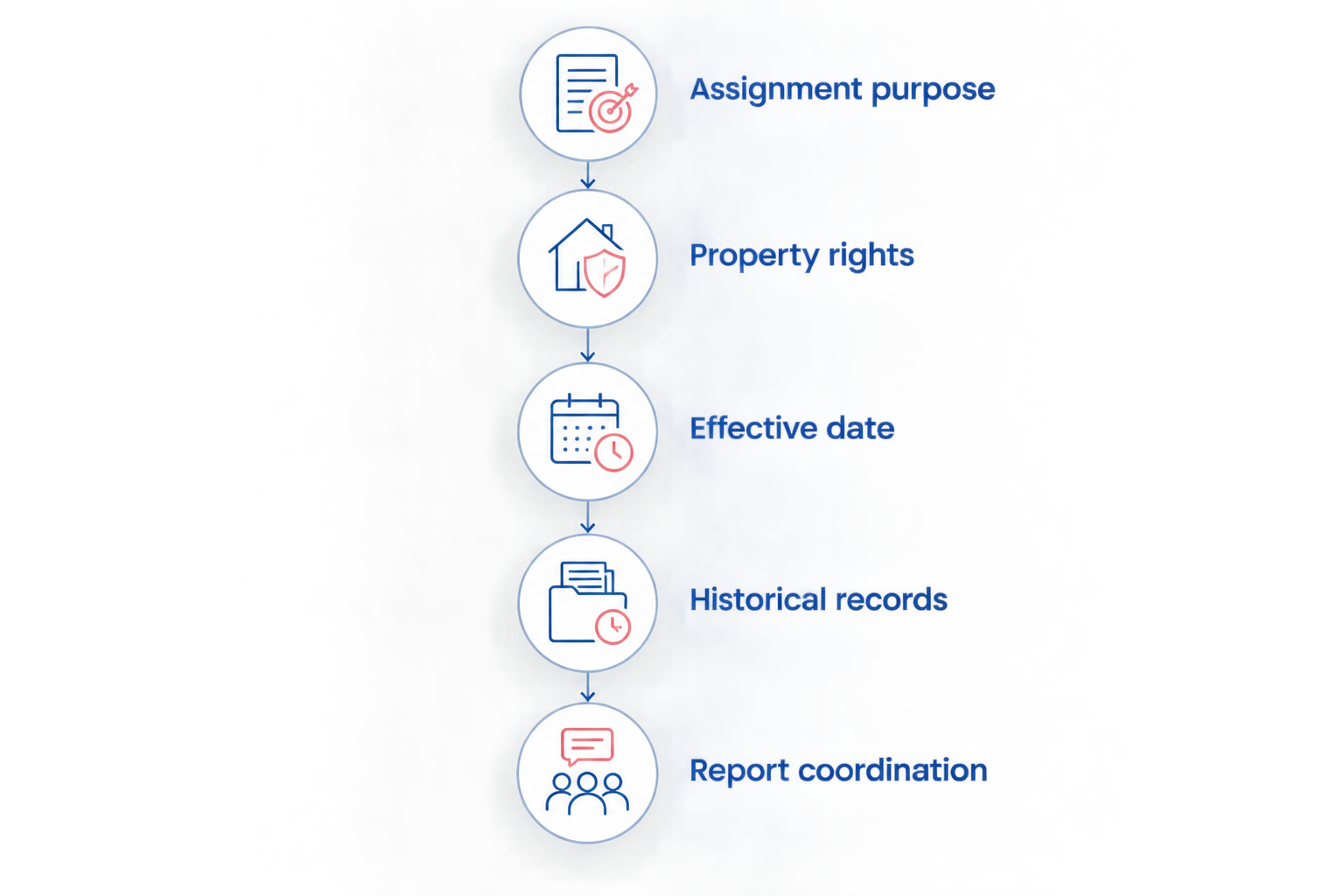
Use this sequence to organize the brief:
- Assignment purpose: Identify the estate reporting or administration need and the advisers involved.
- Property rights: Describe the property, ownership structure, and interest requiring valuation.
- Effective date: Obtain the applicable date from the responsible advisers rather than substituting the inspection date.
- Historical records: Collect materials showing the property's condition, use, occupancy, and financial circumstances at that date.
- Report coordination: Identify intended users, communication responsibilities, and the requested completion target.
The sequence establishes the assignment before document collection becomes an open-ended exercise. If ownership or the required date remains unresolved, flag that issue before the proposal is finalized.
Keep the effective date and report date separate
A retrospective appraisal involves 2 distinct dates: the effective date of value and the report date. The first identifies when the value opinion applies; the second identifies when the report is issued.
An appraisal issued in 2026 can address a historical effective date. The analysis must still distinguish information relevant to that historical valuation from later events that do not describe conditions at the time.
For preparation, use the guide to obtaining a retrospective appraisal for inherited property. Give the appraiser a chronology of material property changes and identify the source of each historical fact.
Assemble records around the property, not a generic folder
For residential property, gather available deeds or ownership documents, floor plans, photographs, renovation records, and building materials. For income-producing property, add historical leases, rent rolls, operating statements, and information about vacancies or unusual expenses.
For a partial interest, provide the relevant ownership agreements and restrictions. Ask counsel to identify unresolved legal questions instead of expecting the appraisal to establish legal rights.
Preserve original dates and document versions. A current spreadsheet summarizing historical figures is easier to assess when the underlying source records accompany it.
Confirm scope and timing in writing
Turnaround depends on property type, complexity, records availability, and scope. Confirm expedited availability individually rather than building the estate's filing plan around an assumed delivery date.
The proposal should also explain what happens when missing records or a newly identified ownership issue changes the assignment. Agree on who can authorize scope changes and who will receive follow-up questions.
Discuss Your Appraisal Assignment
Share the property, ownership interest, effective date, and intended use for an assignment-specific discussion.
Which appraisal service should a CPA choose?
Start with the property and interest, then select the appraisal scope. A straightforward residential holding calls for different analysis than a leased commercial building or a restricted ownership interest.
REIS Group's date of death appraisal services give New York City CPAs a relevant starting point for residential, commercial, and partial-interest estate assignments. Request a proposal that names the valuation subject, effective date, intended users, and intended use—not simply an appraisal of the address.
FAQ
What’s the right date of death appraisal for CPAs handling a New York estate?
The right assignment values the identified property interest at the applicable historical date for the stated estate purpose. Choose residential, commercial, or partial-interest expertise according to the asset, and coordinate the scope with the estate attorney.
Can a date of death appraisal be prepared after the death occurred?
Yes. A retrospective appraisal can be prepared later while addressing value at a historical effective date. The appraiser needs sufficient relevant evidence about the property and market at that time.
Is a current appraisal the same as a date of death appraisal?
No. A current appraisal addresses a current effective date, while a date of death appraisal addresses the specified historical date. A current inspection can provide information, but it does not by itself establish historical condition or value.
What documents should a CPA provide to the appraiser?
Provide ownership documents, the requested effective date, the intended use, and available historical property records. Income-producing properties also require relevant leases and operating information, while fractional interests require the applicable ownership agreements.
Does a fractional ownership interest automatically receive a valuation discount?
No. Fractional ownership does not establish a predetermined discount. Any adjustment requires analysis of the actual rights, restrictions, control characteristics, and supporting evidence relevant to the assignment.
Can the same appraisal support estate tax and probate work?
Only when the assignment addresses the requirements of both intended uses. Ask the CPA, attorney, and appraiser to confirm the property rights, effective dates, intended users, and reporting needs before relying on one report for multiple purposes.
Does an appraisal guarantee IRS acceptance?
No appraisal guarantees IRS acceptance or a particular tax outcome. A clearly supported report explains the valuation conclusion for the identified purpose, but a reviewing authority can question its assumptions, evidence, or analysis.
One last thing
The street address does not fully define the asset. The same property can raise different valuation questions depending on the ownership rights and effective date specified in the engagement.
Before requesting a proposal, write one sentence identifying the property interest, valuation date, intended users, and intended use. Discuss your appraisal assignment with those points in hand so the consultation begins with the question the report must answer.
Related guides
- Date of death appraisal: a guide for New York executors and attorneys
- Can one appraisal be used for both estate tax and probate filings?