To appraise commercial property with tenants, identify the ownership rights being valued, review the leases, and analyze the income and expenses those leases create. Then test the resulting value against relevant market evidence rather than treating occupied space as automatically valuable. For a New York City commercial owner commissioning an appraisal in 2026, the practical starting point is a complete lease package and a clearly stated valuation purpose.
- To appraise commercial property with tenants, analyze lease obligations and property rights before converting income into value.
- REIS Group serves New York City commercial owners needing purpose-defined real estate appraisals.
- Contract rent, market rent, vacancy, operating expenses, and lease rollover require separate analysis.
- A leased-fee appraisal values the landlord’s interest subject to existing leases, not an assumed vacant building.
Why this matters
A full building and a strong rent roll are not the same thing. Below-market leases, unpaid rent, landlord obligations, and clustered lease expirations can affect what a buyer would pay for the ownership interest.
For an owner considering a sale, the appraisal must connect the leases to the property’s anticipated financial performance. REIS Group’s appraisal and valuation services are scoped to the property, ownership interest, effective date, intended users, and intended use. Define that assignment before requesting a value conclusion.
How do you appraise a commercial property with existing tenants?
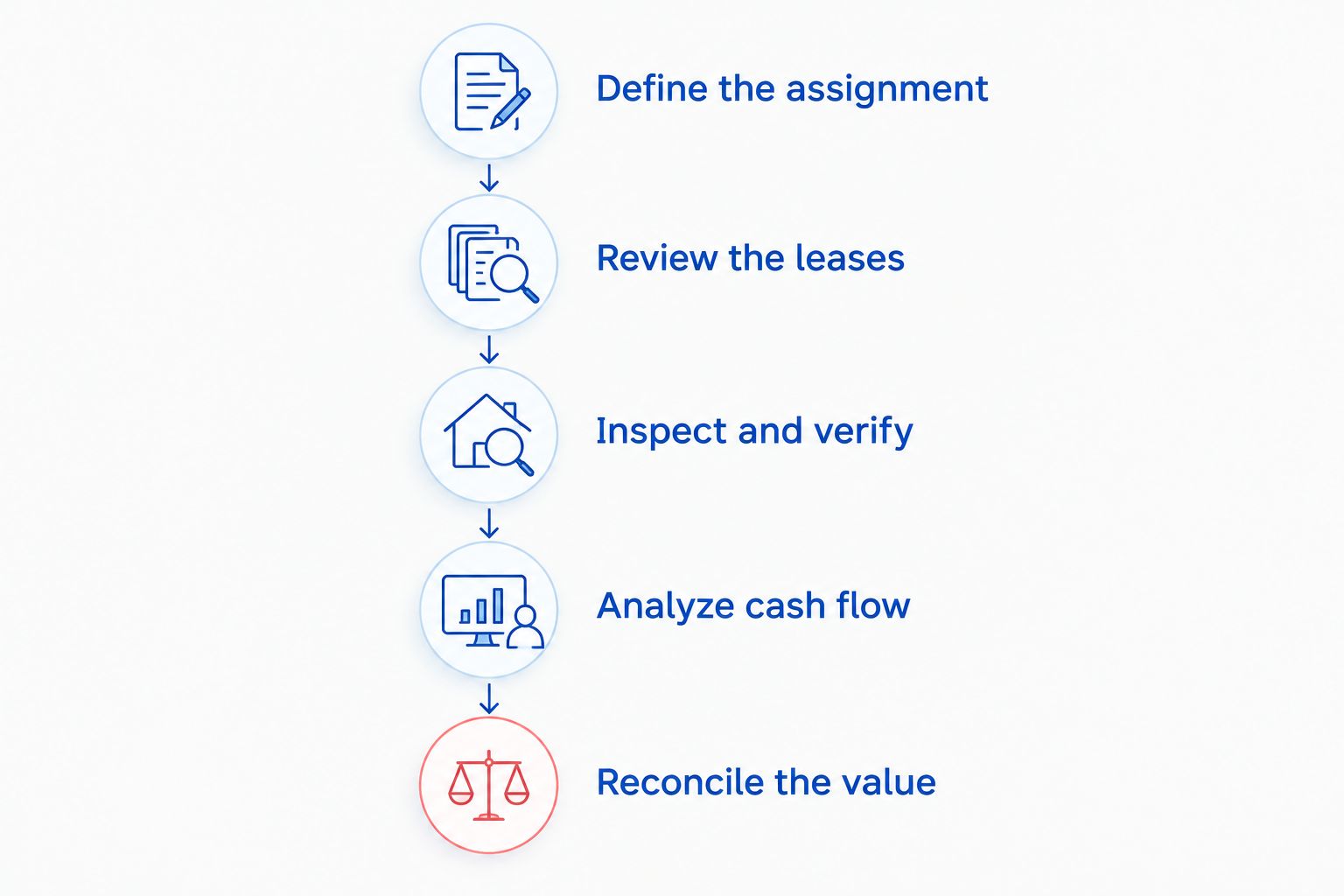
The appraisal process connects legal occupancy rights, property condition, and market-supported income expectations. These steps keep the analysis focused on the interest a buyer would actually acquire.
- Define the assignment. Identify the property, intended use, intended users, effective date of value, and property rights appraised. Establish whether the assignment concerns the entire landlord’s interest or a fractional ownership interest. A sale-planning appraisal and a valuation for another purpose do not automatically have interchangeable scopes.
- Review the leases. Read executed leases together with amendments, extensions, side agreements, and relevant notices. Extract base rent, escalation provisions, expiration dates, renewal options, expense reimbursements, landlord work obligations, and termination rights. A rent-roll entry is a summary, not a substitute for the agreement.
- Inspect and verify. Compare the occupied areas and reported uses with available plans, records, and inspection observations. Identify deferred maintenance, vacant areas, and promised tenant work. Explain material differences between the records and observed conditions rather than silently choosing one version.
- Analyze cash flow. Reconcile scheduled rent with collections, concessions, reimbursements, and operating expenses. Distinguish ongoing expenses from capital expenditures. Evaluate vacancy, collection loss, and leasing costs using evidence relevant to the property and its market.
- Reconcile the value. Select and apply the valuation approaches appropriate to the assignment. Test income assumptions against comparable leasing and sales evidence, explain the treatment of existing leases, and reconcile the indications into a supported conclusion.
For an effective date in 2026, the analysis must reflect conditions relevant to that date. A lease signed or a tenant departure occurring afterward requires consideration in relation to what was known or reasonably anticipated at the effective date; it is not automatically a substitute for contemporaneous evidence.
Which property rights are being appraised?
For a landlord selling a building subject to existing leases, the relevant interest is generally the leased-fee interest. That means the ownership interest remains subject to the tenants’ contractual rights. Confirm the required interest rather than assuming every commercial appraisal answers the same question.
| Property interest | What the analysis addresses | Best suited to | Limitation |
|---|---|---|---|
| Leased-fee interest | The landlord’s ownership subject to existing leases | Analyzing the interest transferred with leases in place | Results depend on the lease terms and related obligations |
| Fee-simple interest | Ownership unencumbered by another interest, subject to governmental limitations | Assignments requiring analysis without the existing lease encumbrances | It does not automatically describe the landlord’s current leased position |
| Leasehold interest | The tenant’s rights under a lease | An assignment concerning the tenant’s interest | It is not the same asset as the landlord’s ownership |
Above-market contract rent can benefit a landlord while it remains collectible and enforceable. Below-market rent can constrain income during the remaining lease term. Neither observation determines the adjustment by itself: remaining duration, options, expenses, and market evidence still matter.
If the owner holds property through an entity, distinguish the real estate interest from an ownership interest in that entity. Appraising business-owned real estate is not the same assignment as valuing the operating business.
Which valuation approach fits a tenanted property?
The income approach is directly relevant to income-producing real estate, but choosing it does not eliminate the need for market verification. The appraiser determines which approaches provide credible evidence for the assignment.
| Approach or method | Best suited to | Strength | Limitation |
|---|---|---|---|
| Direct capitalization | Properties with income that can be reasonably stabilized | Connects a supported income measure with a market-derived capitalization rate | A single-period model can obscure significant lease changes |
| Discounted cash flow | Properties with material changes in income, expenses, or occupancy | Models changes over the projection period explicitly | Results depend on supported timing, leasing, and discount-rate assumptions |
| Sales comparison | Properties with relevant transaction evidence | Tests value against observed sales | Differences in tenancy, rights transferred, and condition require analysis |
| Cost approach | Assignments where land and improvement costs provide relevant evidence | Examines the contribution of the physical improvements | Depreciation and market obsolescence can be difficult to measure |
Direct capitalization divides an appropriate annual net operating income by a supported capitalization rate. Discounted cash flow brings projected cash flows and a terminal value back to the effective date. Neither method corrects an inaccurate lease abstract or an unsupported income forecast.
Why tenanted commercial property values vary
Existing tenants affect more than the rent line. These factors determine how contractual income relates to market expectations:
- Rent position. Contract rent above or below market affects the landlord’s position over the enforceable lease term. Compare equivalent lease structures, not just headline rents.
- Lease rollover. Expirations and termination rights affect when income can change. Several leases ending together present a different cash-flow pattern from staggered expirations.
- Collection risk. Arrears, concessions, and documented payment disputes distinguish scheduled income from income actually received. Occupancy alone does not demonstrate collectibility.
- Expense allocation. Reimbursement provisions determine which operating costs remain with the landlord. Lease labels alone do not establish the allocation.
- Physical and functional condition. Deferred maintenance, building systems, layout, and required tenant work affect expenditures and the property’s competitive position.
- Market evidence. Comparable rents, concessions, sales, and investor return requirements must fit the property and effective date. Broad New York City averages do not replace evidence relevant to the subject building.
For a 2026 assignment, use evidence appropriate to the building’s location, property type, and valuation date rather than attaching a current-year label to older assumptions.
What documents should an owner provide?
Provide an organized package that lets the appraiser reconcile contractual obligations with actual operations. For each document, identify its date and explain whether it describes conditions at the effective date or a later development.
Lease records
Supply executed leases, amendments, extensions, guaranties, side agreements, and available tenant correspondence concerning material changes. Include a rent roll identifying occupied and vacant spaces, lease expirations, and concessions. Flag unsigned proposals separately from binding agreements.
Operating records
Provide historical operating statements and a current budget, with supporting detail for unusual entries. A trailing 12-month operating statement is a starting document, not proof of stabilized annual income. Include collection records and an arrears schedule so the appraiser can distinguish billed rent from receipts.
Property records
Gather floor plans, area schedules, available surveys, tax bills, insurance information, maintenance records, and capital expenditure information. Identify known physical issues and landlord obligations for tenant improvements. Explain differences between rentable areas, usable areas, and figures appearing in public records.
Assignment instructions
State the intended use, required effective date, ownership interest, intended users, and requested reporting requirements. For an appraisal ordered during 2026 with an earlier effective date, provide records describing the property and tenancy as of that earlier date. Current records alone cannot establish historical conditions.
How should shared expenses and reimbursements be treated?
Analyze the landlord’s actual obligations and the tenant’s reimbursement obligations together. A reimbursement is not an additional benefit without considering the expense it offsets. Likewise, an expense appearing in the owner’s accounts does not establish that the owner ultimately bears the full amount.
Read allocation formulas, exclusions, caps, base-year provisions, and reconciliation terms. Identify whether reimbursements shown in the operating statements reflect amounts billed, amounts collected, or accounting adjustments. Applying the same treatment consistently across the income and expense analysis prevents distorted net operating income.
Jurisdiction also matters. Assumptions about business rates for shared buildings in the United Kingdom should not be imported into a New York property-tax analysis. Establish the applicable local charges and contractual allocation rather than treating similarly named occupancy costs as equivalent.
How do you test whether the income conclusion makes sense?
Start with a bridge from the rent roll to the appraisal’s income estimate. Explain the differences attributable to vacancy, concessions, arrears, reimbursements, market-rent adjustments, and lease expirations. An unexplained jump from current collections to stabilized income makes the conclusion harder to evaluate.
Then inspect the treatment of future expenditures. Tenant improvements, leasing commissions, and capital projects need treatment consistent with the selected method; they should not disappear because they are excluded from a particular definition of operating expenses. Avoid deducting the same obligation twice.
REIS Group brings over 30 years of experience to appraisal assignments. For a commercial property owner, the relevant engagement question is still specific: how will the report address the leases, property rights, effective date, and intended use? Experience supports judgment; the report must show the reasoning.
Does full occupancy mean a higher appraised value?
Full occupancy does not by itself establish a higher value. A fully occupied building can carry below-market leases, substantial owner obligations, or documented collection problems, while vacant space requires analysis of leasing risk and costs. The appraisal compares the financial consequences rather than awarding value for occupancy alone.
Should contract rent or market rent be used?
Both contract rent and market rent inform the appraisal, but they answer different questions. Contract rent describes the lease obligation; market rent describes rent supported by comparable market evidence. The property rights appraised and remaining lease terms determine how those figures enter the analysis.
FAQ
Can I appraise a commercial building using only the rent roll?
A rent roll alone does not establish the lease obligations or support a complete income analysis. The appraiser also needs relevant leases, operating records, property information, and market evidence.
Does an occupied commercial property always need a discounted cash-flow analysis?
An occupied commercial property does not automatically require discounted cash flow. The appraiser selects methods appropriate to the assignment, including whether material changes in tenancy or expenses need explicit modeling.
Do tenant security deposits count as rental income?
Refundable tenant security deposits are not ordinary rental income merely because the landlord holds them. Their treatment depends on the deposit obligations, any documented application, and the assignment’s analysis.
What happens if a tenant is behind on rent?
Rent arrears require analysis of collections and collection risk rather than an assumption that scheduled rent will be received. Provide payment records, agreements addressing arrears, and relevant notices.
Can the appraiser assume the building is vacant?
A vacant-property assumption must be appropriate to the assignment and clearly addressed in the appraisal. It does not automatically represent the landlord’s actual interest in a building subject to existing leases.
Does an appraisal of my building include the business operating inside it?
A real estate appraisal does not automatically include an operating-business valuation. Identify whether the assignment concerns real property, an entity interest, an operating business, or separately scoped components.
How long will a tenanted commercial appraisal take?
Turnaround depends on property type, complexity, records availability, and scope. Confirm the schedule for the individual assignment; expedited availability requires separate confirmation.
One last thing
Check the option clauses before treating a lease expiration as an opportunity to reset rent. A renewal option, expansion right, or termination provision can change the cash-flow timeline without changing today’s rent roll. Include those provisions in the initial document package, not as a correction after the analysis is underway.
For a 2026 sale-planning assignment, send the property address, ownership structure, lease package, and intended valuation date when you request an appraisal consultation. REIS Group can discuss the commercial appraisal scope needed to address the existing tenancies and your identified purpose.
Related guides
- How to vet a commercial appraiser before hiring in New York
- How long does a commercial appraisal take?
- Commercial appraisal for property investors