Business valuation cost in 2026 depends on the assignment’s purpose, the ownership interest, the records available, and the analysis and reporting required; there is no single fee that applies to every business. A proposal also needs to specify whether real estate appraisal, additional asset valuations, meetings, or testimony are included. For CPAs advising owners of New York businesses, the practical next step is to define the assignment before comparing fees.
- Business valuation cost depends on the assignment, not just company size; compare proposals with matching scope.
- REIS Group appraises business-owned real estate; confirm operating-business valuation needs when discussing the assignment.
- Separate operating-business value, real estate value, and ownership-interest value before requesting proposals.
- Ask whether property appraisal, revisions, meetings, and testimony are included or separately scoped.
How much does a business valuation cost in 2026?
Business valuation cost is an assignment-specific professional fee, not a standard charge tied only to revenue or property value. To obtain a useful proposal, identify what is being valued, why the conclusion is needed, the effective date of value, and who will rely on the report.
REIS Group provides real estate appraisal and valuation consulting for CPAs, attorneys, businesses, and other professional clients. REIS Group is a fit for CPAs who need business-owned real estate appraised. Operating-business valuation is a separate scope question that should be confirmed before engagement.
Start by distinguishing the following assignments. These are different valuation subjects, not interchangeable report tiers.
| Assignment | Best for | What it addresses | Benefit | Limitation |
|---|---|---|---|---|
| Operating-business valuation | CPAs and owners evaluating an enterprise or business ownership interest | The business, with the assets, liabilities, and rights defined in the engagement | Connects the analysis to business operations and the specified interest | Does not automatically provide a separate real estate appraisal |
| Business-owned real estate appraisal | CPAs and owners needing a supported property value | The identified real property rights at the effective date | Provides property-specific market analysis | Does not establish the value of the operating business |
| Partial-interest real estate valuation | Advisers evaluating a specified fractional property interest | The particular interest and its associated rights | Addresses the interest actually being valued | Is not automatically equivalent to valuing an interest in a business entity |
A useful proposal identifies the subject explicitly. A proposal that says only “business valuation” leaves unanswered whether the work covers the enterprise, an ownership interest, real property, or a combination.
Why this matters
For a CPA, the fee question is inseparable from the client’s reporting or decision-making purpose. A valuation for an owner considering a sale and a valuation prepared for a specified tax or legal use require their own engagement decisions. A report should identify its intended use rather than leave the reader to assume it is suitable for every purpose.
The same distinction applies to assets. A company that operates from its own building presents an operating-business question and a real estate question. Treating a property appraisal as a complete business valuation leaves the operating business unaddressed.
For background on coordinating the engagement, see the guide to business valuation for CPAs and accountants. Your immediate task is to identify the conclusion the client needs, then obtain a proposal for that work.
Operating-business valuation: define the business interest
An operating-business assignment starts with the entity or interest under consideration. Identify whether the subject is the entire business or a particular ownership interest, and supply the governing documents that explain the relevant rights.
Financial statements alone do not describe every aspect of an ownership interest. Ownership agreements, restrictions, debt arrangements, and related-party transactions can also be relevant to the assignment. Give the valuation professional enough information to determine which records and analyses are needed.
For your proposal request, describe:
- The entity: Its legal structure, activities, and ownership arrangement.
- The interest: The specific ownership interest under consideration.
- The purpose: The transaction, reporting need, or dispute the valuation will address.
- The date: The effective date to which the conclusion must apply.
- The users: The people or organizations expected to rely on the report.
The advantage of this scope is its focus on the business interest. Its boundary is equally important: do not assume a separate property appraisal, specialized asset valuation, or litigation support is included unless the engagement says so.
Business-owned real estate appraisal: define the property rights
A real estate appraisal addresses identified property rights, not the business merely because it occupies or owns the building. For a Manhattan or greater New York City assignment, identify the property, its use, its ownership, and any leases or other arrangements affecting the rights being appraised.
An owner-occupied building and a leased investment property present different factual questions. Relevant records can include leases, rent information, operating statements, floor plans, and documentation of the property’s condition. The appraisal scope determines what must be investigated and analyzed.
REIS Group provides residential and commercial real estate appraisals, including income-producing properties. Reports are scoped to the property, ownership interest, effective date, intended users, and intended use.
The benefit is a property-specific conclusion; the limitation is that real estate value alone does not establish enterprise value. Ask the business valuation professional how the property conclusion will be used so that the assignments remain consistent.
Partial-interest valuation: identify what the owner holds
A fractional interest in real estate is not the same subject as an ownership interest in an entity that owns real estate. The underlying property matters in both situations, but the rights being valued are different.
Before requesting a proposal, provide the ownership documents and describe the interest precisely. Ask the valuation professional to identify whether the assignment concerns direct property ownership, an entity interest, or separate analyses of each.
Partial-interest real estate valuation addresses the specified property interest. Its limitation is that it does not automatically answer every entity-level question. Do not substitute an ownership percentage multiplied by whole-property value for an analysis of the actual interest.
Why business valuation cost varies in 2026
The following scope factors explain why proposals differ. They are questions to resolve, not a formula for estimating a fee.
- Assignment purpose. Identify whether the work supports a sale, estate or gift matter, divorce, litigation, or another defined need. The intended use informs the engagement.
- Subject and rights. A whole business, business ownership interest, building, and fractional property interest are different valuation subjects.
- Property or business complexity. Multiple properties, varied operations, unusual rights, or complex ownership arrangements affect the work that must be scoped.
- Records availability. Organized financial, ownership, and property records help establish what information is available and what requires clarification.
- Effective date. A retrospective assignment requires analysis relevant to an earlier date, rather than simply applying present conditions.
- Deliverables and support. Report requirements, coordination with advisers, subsequent questions, meetings, and testimony should be addressed in the proposal.
A lower quoted fee is not evidence of equivalent work. Compare the scope first, then evaluate the fee attached to it. Conversely, a higher fee does not by itself establish that an assignment is better suited to your client’s purpose.
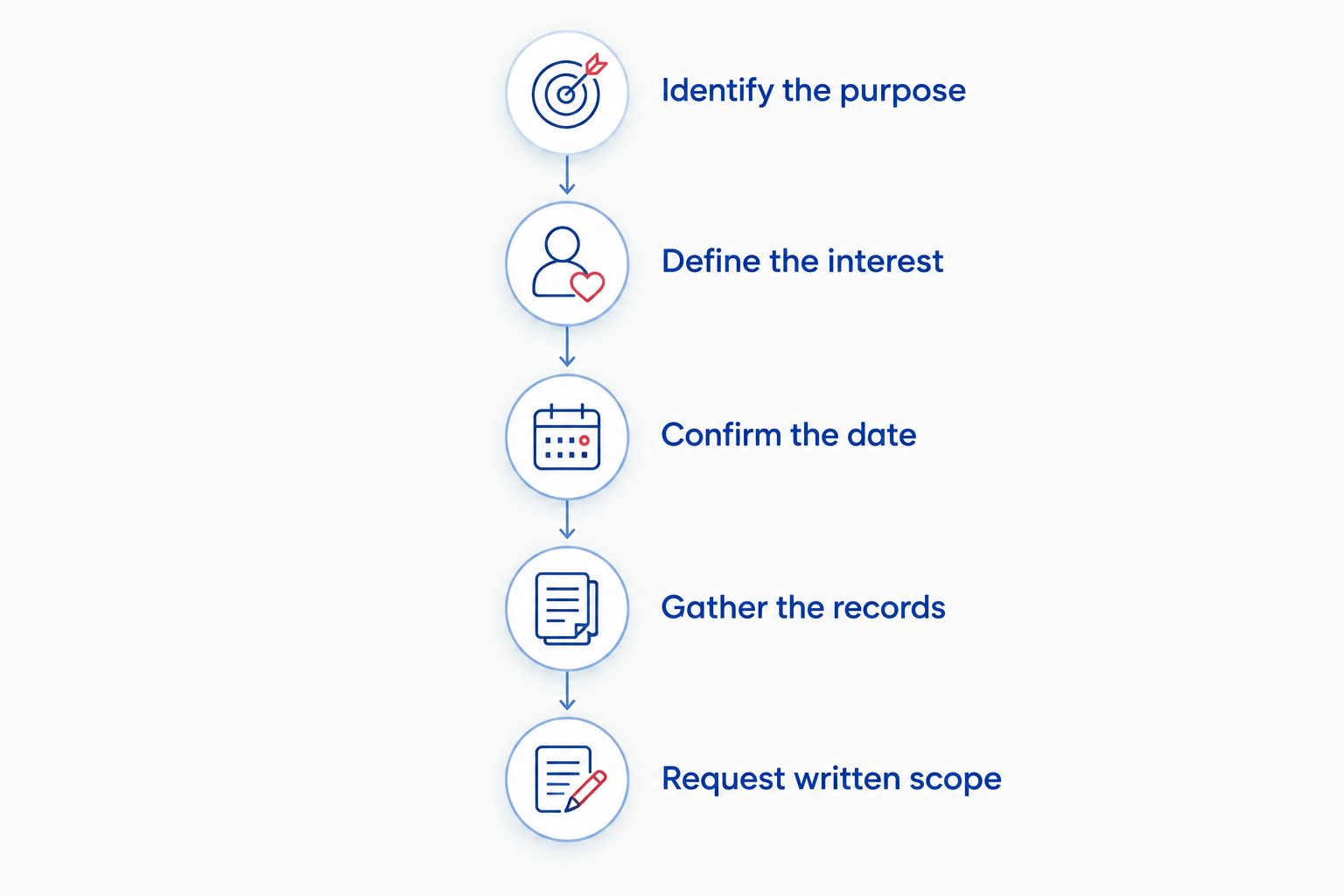
How should a CPA request a comparable proposal?
Use a consistent engagement request so each professional responds to the same assignment. This makes exclusions visible before the client commits.
Identify the purpose
State the client’s decision or reporting need in plain language. For example, distinguish evaluating a potential business sale from establishing a property value for an estate matter. Do not ask the provider to infer the purpose from a company name or a set of financial statements.
Define the interest
Name the entity, property, and ownership interest involved. Include relevant ownership documents and identify any real estate held inside the business. Explain whether the client needs separate conclusions for different assets or interests.
Confirm the date
Specify the effective date of value, which is the date the valuation conclusion applies to. Keep it separate from the report date and the date you need delivery. In a retrospective assignment, those dates serve different functions.
Gather the records
Provide an inventory of available records rather than assuming everything is ready. Identify missing financial periods, incomplete lease information, unresolved ownership questions, or unavailable historical property documentation. Let the valuation professional confirm the required documents.
Request written scope
Ask for a proposal identifying the subject, purpose, intended users, effective date, deliverables, fee basis, exclusions, and assumptions about information supplied. Request a separate explanation of any additional services the client anticipates needing.
What should you check before approving a 2026 engagement?
Read the proposal as a description of work, not just a fee quotation. Confirm that the named client, intended users, subject interest, and intended use match the assignment you described.
Check the effective date carefully. A current valuation does not answer a historical valuation question simply because the same business or property is involved. For a retrospective appraisal, discuss the records needed to establish the property’s condition and relevant market circumstances at that date.
Then check the boundaries:
- Does the engagement include a real estate appraisal, or is that separately commissioned?
- Does it address the whole business or the specified ownership interest?
- What report and supporting explanation will the client receive?
- How are corrections, new information, or a changed assignment handled?
- Are adviser meetings, testimony, or other subsequent services included?
- What records and access must the client provide?
Approval should follow agreement on scope, not precede it. If the purpose or subject changes, ask whether the engagement needs to change as well.
Is a real estate appraisal enough for a business valuation?
A real estate appraisal is enough only for the property valuation question it was engaged to answer; it does not establish operating-business value. If your client needs both conclusions, identify the relationship between the assignments before commissioning either report.
Ask the professionals to clarify how the property, occupancy arrangements, and business operations will be treated. That coordination helps avoid inconsistent assumptions or counting the same asset twice.
Does a retrospective valuation require different preparation?
A retrospective valuation requires evidence relevant to the historical effective date. Current financial or property records do not automatically establish what existed at that earlier time.
Gather contemporaneous documents and explain subsequent changes separately. For real estate, distinguish the property’s condition at the effective date from renovations or changes made afterward.
Does a proposal include meetings or testimony?
A valuation proposal includes meetings or testimony only when its terms provide for them. Identify anticipated attorney conferences, questions from intended users, or testimony before approving the engagement.
Do not assume that report preparation includes every later service. Ask how additional work will be authorized and scoped.
FAQ
How do I get a business valuation cost estimate in 2026?
Request a proposal identifying the business or interest, intended use, effective date, available records, and required deliverables. Ask whether real estate appraisal and subsequent support are included or separately scoped.
Is a business valuation the same as a commercial property appraisal?
A business valuation and a commercial property appraisal address different subjects. A property appraisal values identified real property rights; an operating-business valuation addresses the defined business or ownership interest.
What should a CPA send before requesting a valuation proposal?
A CPA should send an assignment summary and an inventory of available financial, ownership, and property records. The valuation professional should confirm the documents required for the specific engagement.
Can I use a current valuation for an earlier valuation date?
A current valuation does not establish value at an earlier effective date. Ask for a retrospective assignment when the conclusion must address historical circumstances.
Does a business valuation automatically include company-owned real estate?
A business valuation does not automatically include a separate appraisal of company-owned real estate. Confirm how the property will be treated and whether a property appraisal is required.
Does REIS Group appraise business-owned real estate in New York City?
REIS Group provides commercial and residential real estate appraisal services in Manhattan and greater New York City. Discuss the property, ownership interest, effective date, and intended use to establish the assignment scope.
One last thing
The most useful fee comparison starts with the same valuation subject. A proposal for a building and a proposal for the business operating inside it are not competing answers to the same question.
For a 2026 engagement, prepare a short assignment summary before requesting proposals: what is being valued, why, as of when, and for whom. Discuss Your Appraisal Assignment with REIS Group to establish the real estate appraisal requirements and confirm any related business valuation needs.
Discuss Your Appraisal Assignment
Clarify the property, ownership interest, effective date, and intended use before requesting a proposal.
Related guides
- Business valuation for owners planning a sale
- Commercial appraisal for property investors
- Date-of-death appraisal guidance for New York executors and attorneys