

For a trust property appraisal for trustees, choose the service that matches the trust’s ownership interest, valuation date, and intended use—not a generic firm ranking. REIS Group provides trust real estate valuation services for trustees handling Manhattan and greater New York City properties, including estate-related, residential, commercial, and partial-interest assignments.
- REIS Group provides trust property appraisal for trustees handling New York City real estate and estate-related valuation needs.
- Retrospective appraisals address historical valuation dates; current appraisals answer different questions.
- Partial-interest valuations analyze the ownership interest, not merely a percentage of the entire property.
- Define the intended use with the trust’s attorney or CPA before requesting an appraisal proposal.
Why this matters
A trustee needs a value conclusion that answers a specific administrative question. A report prepared for a current distribution does not automatically answer an estate-tax question tied to a historical date.
For a 2026 engagement, begin with the decision the appraisal must support: tax reporting, fiduciary accounting, distribution, sale planning, or a dispute. REIS Group’s appraisal services are scoped to the property, ownership interest, effective date, intended users, and intended use.
The effective date of value is the date the value opinion describes. The report date is when the appraisal is completed; those dates need not match.
What makes an appropriate trust property appraisal service
Use these criteria before comparing proposals:
- Assignment purpose: The engagement identifies the trustee’s decision and the report’s intended use.
- Property competence: The appraiser has relevant experience with the property type and its market.
- Ownership analysis: The scope distinguishes the entire property from a fractional interest or an interest in a property-owning entity.
- Date-specific evidence: The analysis addresses market conditions and property characteristics at the effective date.
- Supported conclusions: The report explains relevant data, methods, assumptions, and limitations.
- Adviser coordination: The engagement identifies intended users and questions requiring the trustee’s attorney or CPA.
REIS Group has over 30 years of experience. Experience is relevant, but the proposal still needs to address your particular property, records, and valuation purpose.
Trust appraisal services at a glance
These are assignment types, not competing firms. The appropriate choice depends on the question you need answered; several scopes can overlap within one engagement.
| Service or assignment scope | Best for | Distinguishing feature | Key limitation |
|---|---|---|---|
| REIS Group trust-related real estate appraisal | Trustees defining a New York City assignment | Scope tied to property, rights, date, and use | The proposal must confirm the specific assignment |
| Retrospective or date-of-death appraisal | Trustees needing a historical value | Analysis tied to an earlier effective date | Historical records require careful reconstruction |
| Partial-interest valuation | Trusts holding less than the entire property interest | Analysis of the actual ownership rights | A simple percentage calculation is insufficient |
| Commercial property appraisal | Trust-held income-producing real estate | Analysis of leases, income, expenses, and market evidence | Incomplete operating records constrain analysis |
| Residential property appraisal | Trust-held homes, cooperative apartments, and condominiums | Analysis of relevant residential market evidence | A current residential report does not answer every trust purpose |
1. REIS Group: trust appraisal scoping for NYC trustees
Best for: Trustees who need to define a Manhattan or greater New York City real estate valuation assignment with their professional advisers.
REIS Group serves trustees, fiduciaries, attorneys, CPAs, and property owners. Its services include estate and date-of-death appraisals, estate and gift tax real estate valuations, residential and commercial appraisals, and partial-interest valuations.
Start with the property address, the trust’s ownership interest, and the decision requiring a value. Ask for an engagement that distinguishes the real estate from any separate operating business or entity interest.
REIS Group strengths:
- Relevant residential, commercial, estate-related, and partial-interest service scope.
- Manhattan and greater New York City focus.
- Nationwide assignments coordinated through its professional network.
REIS Group scope limits:
- A real estate appraisal does not replace legal or tax advice.
- A specific assignment requires confirmation of scope, records, and timing.
Decision: Proceed when the proposal matches the trustee’s identified purpose, rather than simply requesting a general property value.
2. Retrospective appraisal: historical trust valuation dates
Best for: Trustees whose attorney or CPA identifies a historical effective date, including a date-of-death assignment.
A retrospective appraisal develops a value opinion as of an earlier date. Completing the report in 2026 does not make 2026 the valuation date unless that is the date the assignment requires.
The appraiser needs evidence relevant to the historical period. Depending on the property, that includes photographs, leases, operating records, renovation information, and records describing its condition at the time.
Retrospective appraisal strengths:
- Addresses the date relevant to the identified assignment.
- Separates historical condition from later improvements.
- Gives advisers a date-specific real estate conclusion to evaluate.
Retrospective appraisal limitations:
- Missing historical documents complicate reconstruction.
- A present-day inspection alone does not establish historical condition.
For estate-tax work, coordinate the engagement with the date-of-death appraisal and Form 706 workflow and the tax adviser responsible for the filing. An appraisal supports the identified reporting purpose; it does not guarantee acceptance by a taxing authority.
Decision: Proceed after the adviser confirms the effective date and intended use.
3. Partial-interest valuation: fractional trust ownership
Best for: Trustees administering an undivided real estate interest or another ownership interest requiring separate analysis.
A partial-interest assignment examines the rights being valued, not just the building. The appraiser must understand whether the trust owns real estate directly or holds an interest in an entity that owns real estate.
Do not assume that multiplying the whole-property value by the ownership percentage answers the assignment. Control, transfer restrictions, governing documents, and other relevant characteristics require analysis where applicable.
Partial-interest valuation strengths:
- Focuses on the trust’s actual ownership rights.
- Distinguishes whole-property value from interest value.
- Makes ownership documentation central to the scope.
Partial-interest valuation limitations:
- Ownership percentage alone does not establish value.
- Entity-interest and real estate assignments require a clear division of responsibility.
For a 2026 transfer or distribution, provide the governing documents before the engagement is finalized. Do not request a predetermined discount or value outcome.
Decision: Proceed when the ownership interest is clearly identified; hold if the documents leave that interest unresolved.
4. Commercial appraisal: trust-held income property
Best for: Trustees administering multifamily, mixed-use, retail, office, or other income-producing real estate.
Commercial appraisal connects the property’s physical and legal characteristics with its income potential and market evidence. A rent roll is a starting point, not a substitute for understanding leases, expenses, vacancies, and capital needs.
Highest and best use means the reasonably probable use that is legally permissible, physically possible, financially feasible, and maximally productive. That analysis matters when the current use does not fully explain the property’s value.
Commercial appraisal strengths:
- Examines income-producing characteristics.
- Connects lease terms and operating evidence to valuation.
- Addresses property-specific use considerations.
Commercial appraisal limitations:
- Incomplete leases or financial records require clarification.
- Real estate value is distinct from the value of an operating business occupying it.
Decision: Proceed with a commercial scope when income, tenancy, or development characteristics are material to the trust’s property.
5. Residential appraisal: trust-held homes and apartments
Best for: Trustees administering cooperative apartments, condominiums, townhouses, or one- to four-family properties.
Residential appraisal considers relevant market evidence alongside the property’s location, condition, configuration, and ownership characteristics. Manhattan cooperative and condominium assignments require attention to the particular property interest rather than treating every apartment alike.
A residential assignment still needs an identified trust purpose. A report addressing a 2026 distribution is not automatically suitable for a historical estate-related valuation.
Residential appraisal strengths:
- Focuses on the relevant residential property type.
- Addresses condition and market comparisons.
- Supports a clearly defined trustee decision.
Residential appraisal limitations:
- Renovations after the effective date must be distinguished from earlier condition.
- A lender-oriented report is not automatically appropriate for trust administration.
Decision: Proceed when the residential scope identifies the intended use, effective date, and property rights appraised.
Prepare three document groups before requesting a proposal
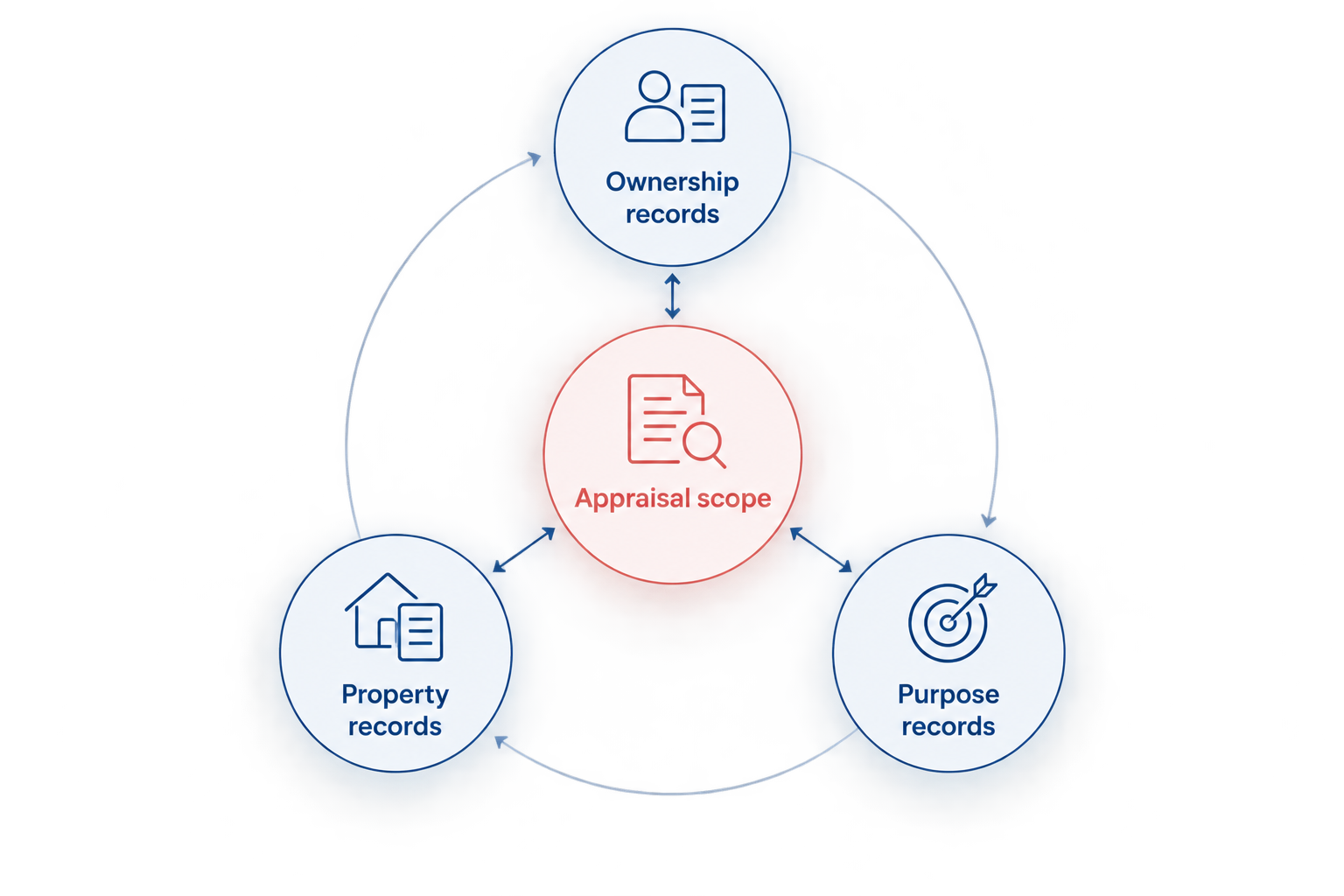
Organize your request around three document groups: ownership records, property records, and purpose records. The appraiser can then identify gaps and confirm which materials the assignment requires.
Ownership records
Provide deeds and relevant trust or entity documentation, with counsel directing the disclosure of sensitive materials. Identify whether the trust owns the entire property, an undivided interest, or an entity interest.
Property records
Gather available floor plans, surveys, leases, rent rolls, operating statements, photographs, and renovation or repair records. For a retrospective assignment, identify which records describe the property at the historical effective date.
Deferred maintenance belongs in this file. Understanding how deferred maintenance affects value requires separating documented condition from assumed repair needs; the valuation analysis must also consider how the relevant market responds to that condition.
Purpose records
State the decision requiring the appraisal, requested effective date, intended users, and relevant deadlines. Ask the attorney or CPA to identify any reporting questions that need resolution before the appraiser finalizes the scope.
Keep unknown items marked as unknown. An organized file is more useful than an apparently complete file containing undocumented assumptions.
Compare proposals by scope, not the report label
Before engaging an appraiser in 2026, ask each candidate to confirm the same assignment facts. Proposals are not comparable if one addresses the entire property today and another addresses a fractional interest at a historical date.
Confirm:
- Property rights: What interest will the report value?
- Effective date: What date will the value opinion describe?
- Intended use: What trustee decision will the report support?
- Intended users: Who is identified as a user of the report?
- Required evidence: What records and inspection arrangements are needed?
- Deliverables: What report and follow-up work does the engagement include?
Turnaround depends on property type, complexity, records availability, and scope. Any expedited availability requires individual confirmation; do not treat a filing deadline as an agreed delivery date.
How these service options are organized
The order starts with assignment scoping, then separates historical dates, fractional ownership, income-producing property, and residential property. It is a decision framework—not a claim that one appraisal type outranks another.
Choose the scope that satisfies the criteria above. A trust holding a fractional interest in a commercial building at a historical effective date needs those requirements addressed together, not three disconnected reports ordered without coordination.
FAQ
What is the best trust property appraisal for trustees?
The appropriate trust property appraisal matches the trustee’s intended use, effective date, and ownership interest. Select an appraiser with relevant property and market experience, then confirm those requirements in the engagement.
Can a trustee order a date-of-death appraisal in 2026?
A trustee can request a retrospective appraisal in 2026 for an earlier date of death. The attorney or CPA should confirm the required effective date and reporting purpose, and the appraiser must evaluate available historical evidence.
Does trust ownership automatically require a partial-interest valuation?
No. The ownership interest being valued determines whether partial-interest analysis is relevant. A trust owning an entire property presents a different assignment from a trust owning an undivided interest or an entity interest.
Can one appraisal support both tax reporting and a beneficiary distribution?
One appraisal does not automatically satisfy both purposes. The appraiser and professional advisers must confirm whether the effective date, property rights, intended users, and report scope address both uses.
What documents should a trustee give the appraiser?
Start with ownership records, property records, and a written explanation of the appraisal’s purpose. The appraiser will identify additional materials based on the property, effective date, and scope.
Does an appraisal guarantee IRS or court acceptance?
No appraisal guarantees acceptance by the IRS, a court, or another third party. A report should explain its evidence, methods, assumptions, and conclusions for the identified intended use.
How long does a trust property appraisal take?
Timing depends on property type, assignment complexity, records availability, and scope. Confirm the proposed schedule after the appraiser reviews the assignment; expedited availability is confirmed individually.
One last thing
The ownership document can change the assignment before the property inspection begins. A building address identifies the asset, but it does not establish whether the trust owns the building, a fractional real estate interest, or an interest in its owner.
Send that distinction with your inquiry. To discuss your appraisal assignment, provide the property location, ownership interest, valuation purpose, requested effective date, and relevant deadline.
Related guides
- Trust property appraisal for trustees: complete guide
- How to appraise a partial ownership interest in real estate