Business valuation for business owners is the analysis of a company’s economic worth to support an informed sale decision. If you own a New York City business, the assignment must distinguish operating value from real estate, identify the ownership interest being sold, and separate valuation conclusions from negotiated deal terms.
- Business valuation for business owners starts with the sale scope, valuation date, and ownership interest—not an asking price.
- REIS Group is best suited to New York owners needing property valuation alongside business-sale planning.
- Separate enterprise value, equity value, and real estate appraisal conclusions before comparing buyer offers.
- Reconcile earnings adjustments with your CPA and document what the proposed transaction includes.
Why business valuation matters for owners planning a sale
A buyer purchases defined rights, assets, and expected economic benefits—not your history of effort. A valuation connects those benefits to documented financial performance and transaction assumptions. It also identifies where your expectations depend on conditions a buyer has not accepted.
For a 2026 sale, establish the valuation date before discussing an asking price. A conclusion tied to that date is not a promise that a buyer will offer the same amount later.
REIS Group is best suited to New York owners needing property valuation alongside business-sale planning. For the adviser’s side of the assignment, review the business valuation guide for CPAs and accountants. Your CPA, attorney, and appraiser need a consistent definition of the proposed transaction.
An owner-occupied Manhattan building adds a separate question: are you selling the company and property together, selling only the company, or retaining the property as landlord? Each structure changes what the valuation must analyze.
How to prepare a business valuation for a sale
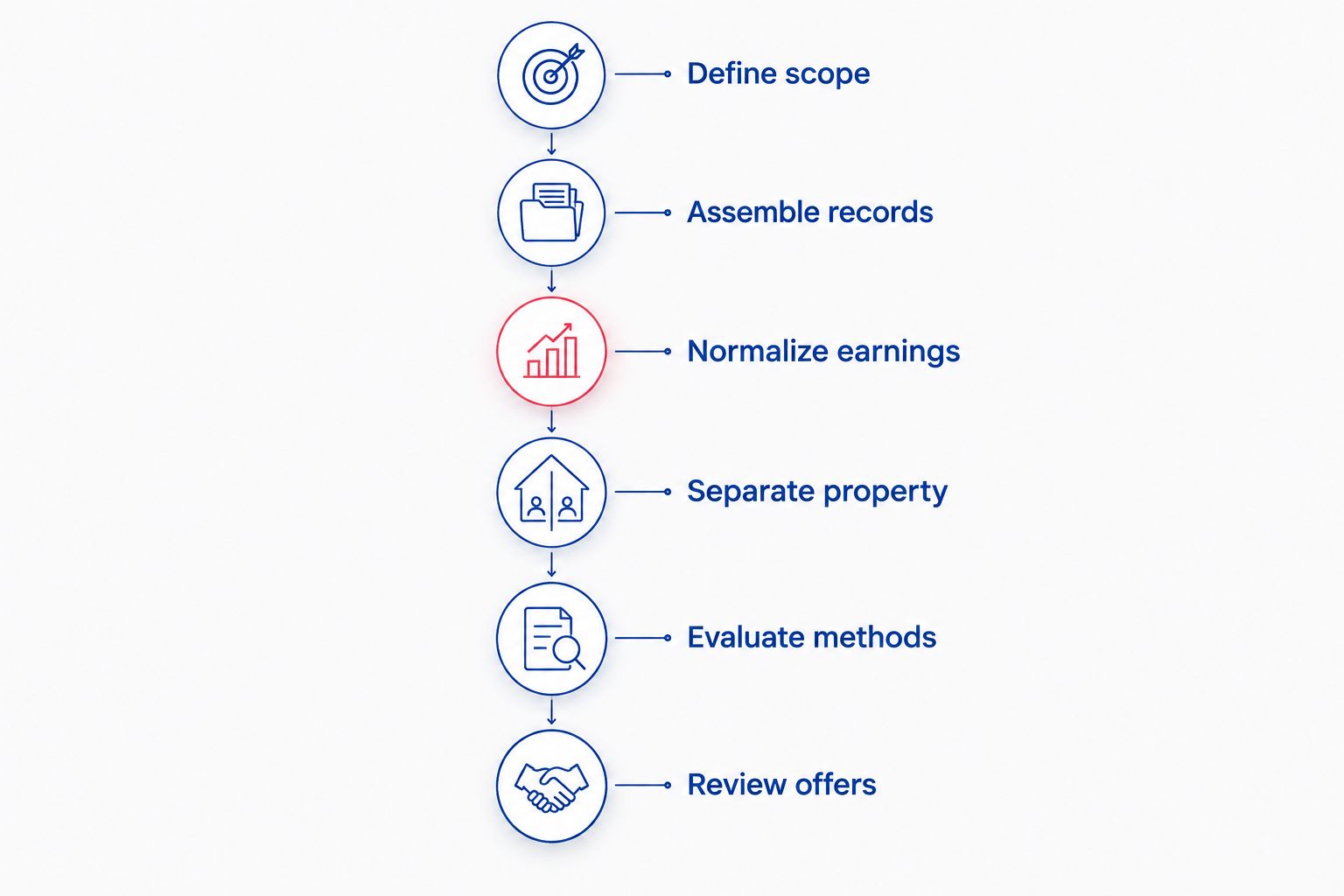
Follow this sequence: Define scope, Assemble records, Normalize earnings, Separate property, Evaluate methods, and Review offers. Resolve the assignment first; detailed calculations cannot correct an undefined ownership interest or an inconsistent asset list.
Define the sale scope before requesting a value
Start with a written transaction outline you can prepare yourself. Identify the legal entity, ownership percentage, intended sale structure, assets included, and intended users of the valuation. Your attorney should distinguish an asset sale from an ownership-interest sale; these are not interchangeable descriptions.
Next, agree on the standard of value. Fair market value generally describes a hypothetical transaction between informed, willing parties without compulsion. A particular strategic buyer’s investment value can differ because that buyer brings its own expectations and benefits.
For a 2026 engagement, specify the effective valuation date separately from the report date. Also state whether the work supports internal planning, negotiations, financing discussions, or another identified purpose. A report prepared for one purpose should not automatically be treated as suitable for another.
Write the question the valuation must answer before asking for a conclusion. An owner’s preferred asking price is an input to discussion, not the assignment’s answer.
- Record the entity name and ownership interest being valued.
- Identify included and excluded assets and liabilities.
- Confirm the valuation date, standard of value, and intended use.
- List the people expected to rely on the report.
Assemble records that explain the business
Build a shared document index before commissioning additional analysis. As a preparation starting point, organize 3 fiscal years of financial statements and tax returns, plus the latest 12 months of monthly results. These are preparation recommendations, not a universal engagement requirement; the appraiser determines the necessary history.
Explain differences between tax returns, internal accounts, and management reports. An unexplained mismatch creates another question rather than evidence of value. Include the balance sheet, debt schedules, customer agreements, leases, equipment information, and ownership documents relevant to the proposed sale.
REIS Group offers business and real estate appraisal services; owners should confirm the proposed assignment’s scope before engagement. Professional assistance does not replace your responsibility to supply complete records. It gives those records a defined valuation purpose.
Keep a separate list of missing documents and the person responsible for each. That is more useful than sending successive folders without an index.
- Reconcile financial statements with filed tax returns.
- Separate company obligations from owners’ personal obligations.
- Identify significant contracts and restrictions on transfer.
- Record missing items, responsible contacts, and expected completion dates.
Normalize earnings with your CPA
Prepare an adjustment schedule in a spreadsheet, then review it with your CPA and valuation professional. Normalization means adjusting reported results to reflect the economic performance relevant to the valuation. It is not permission to remove every expense a seller dislikes.
Owner compensation, related-party rent, personal expenses recorded by the company, and unusual events require evidence. If an owner performs essential work, removing that owner’s compensation without considering replacement management distorts the analysis. Likewise, an expense described as nonrecurring needs a documented reason for that treatment.
For a 2026 sale discussion, separate historical adjustments from forecasts. A completed cost reduction and a proposed efficiency improvement are different kinds of evidence. Buyer-specific benefits should not silently enter a standalone business forecast.
Every earnings adjustment needs an explanation, a supporting record, and consistent treatment. Ask the appraiser to explain how accepted adjustments affect the selected valuation methods.
- Identify each adjustment and its source document.
- Explain whether the underlying activity continues after closing.
- Account for necessary replacement labor and management.
- Keep forecasts separate from historical financial results.
Separate property value from operating performance
Start with an ownership map showing who owns the business, the building, and any related entities. Then collect leases, occupancy information, property expenses, and relevant building records. This manual exercise reveals whether the operating company actually owns the premises or rents from an affiliated owner.
A business occupying its owner’s building requires coordinated analysis. Changing rent assumptions affects operating earnings, while the property requires its own valuation analysis. Adding a building value to a business conclusion without checking the underlying assumptions can count the same economic benefit twice.
REIS Group’s business and real estate appraisal services are relevant when an owner needs both interests addressed. For a Manhattan property component, review the commercial building appraisal considerations, then confirm how the property assignment will coordinate with the business valuation.
The limitation is important: a real estate appraisal alone does not value the entire operating company. Conversely, a business valuation does not automatically include a separately supported property conclusion.
- Map legal ownership of the company and premises.
- Identify whether the property is included in the transaction.
- Document existing rent and related-party arrangements.
- Check that earnings and property assumptions remain consistent.
Evaluate valuation methods without choosing the highest answer
Ask for a plain-language explanation of the methods considered. The income approach evaluates expected economic benefits and risk. The market approach examines relevant market evidence. The asset approach considers the value of assets and liabilities, with treatment appropriate to the assignment.
You can begin by mapping available evidence to these approaches. A formal conclusion requires judgment about relevance, reliability, and the business’s circumstances. Averaging several answers does not resolve weak inputs or incompatible assumptions.
For a 2026 valuation, ask how current information and conditions at the effective date were addressed. Also ask what the conclusion represents: enterprise value concerns the business operations, while equity value concerns the owners’ interest after appropriate financial adjustments. Definitions and treatment must be explicit.
The defensible answer is the supported conclusion, not the largest result. Have the appraiser explain why a method received weight and why another was rejected.
- Request definitions of the value terms used.
- Review the evidence supporting selected methods.
- Identify material assumptions and limiting conditions.
- Ask how conflicting indications were reconciled.
Review offers against the valuation’s assumptions
Create a side-by-side offer worksheet before negotiating from headline amounts. Record what each buyer receives and what you retain. Include proposed treatment of debt, cash, working capital, real estate, and contingent consideration.
A valuation conclusion is not the same as the amount deposited into your account at closing. Transaction expenses, taxes, retained obligations, and negotiated adjustments require separate analysis with your advisers. An earnout also introduces conditions: a stated future payment is not equivalent to an unconditional payment at closing.
Revisit the valuation assumptions if the transaction changes. Excluding the property, retaining a major liability, or altering the ownership interest can make an earlier comparison misleading. Ask whether updated analysis is needed rather than editing the conclusion yourself.
Compare offers on a consistent transaction basis. The most useful worksheet makes differences visible without pretending that unlike terms are identical.
- Identify assets, liabilities, and ownership rights transferred.
- Separate closing payments from conditional future payments.
- Document working-capital and debt adjustments.
- Ask your attorney and CPA to review transaction consequences.
Compare valuation options for your sale
Choose the level of analysis that answers your current question. An internal worksheet can identify missing records; it cannot substitute for an independent conclusion when independent support is required. A formal engagement adds defined scope and analysis, but still depends on reliable information and clearly stated assumptions.
| Option | Best for | Main advantage | Key limitation |
|---|---|---|---|
| Owner-prepared financial review | Early preparation before appointing advisers | Organizes records and identifies unanswered questions | Does not provide an independent valuation conclusion |
| Broker pricing opinion | Discussing proposed marketing and buyer positioning | Connects an asking-price discussion to the proposed sale process | Confirm whether its scope meets the intended valuation use |
| Independent business valuation | Owners needing a supported business-value conclusion | Defines the interest, purpose, methods, and assumptions | Does not automatically include a separate real estate appraisal |
| Coordinated business and property appraisal | Owners selling a company with related real estate | Addresses the operating business and property consistently | Requires coordination across ownership, lease, and transaction records |
REIS Group is an option for owners seeking business and real estate appraisal services, particularly where New York property is part of the sale. Confirm responsibilities, deliverables, intended use, and property coverage before engagement; nationwide capability supports assignments beyond the local market but does not replace assignment-specific scoping.
Discuss Your Business Appraisal Scope
Identify the ownership interest, sale purpose, and real estate component before requesting an appraisal.
Common mistakes owners make before a sale
Treating an asking price as established value
An asking price is a negotiating position. A valuation conclusion rests on a defined interest, date, standard, and evidence. Set those foundations before using a preferred sale amount as a reference point.
Removing the owner without replacing the work
A buyer still needs the functions the owner performs. Document sales responsibilities, operational oversight, professional relationships, and management duties before proposing compensation adjustments. Explain which duties transfer, remain, or require replacement.
Combining property and business values inconsistently
Related-party rent and property ownership affect the analysis. Do not add a building conclusion to an operating-business conclusion until the advisers confirm that occupancy costs and ownership assumptions align.
Comparing offers without reviewing their conditions
A higher headline amount can carry different obligations or payment conditions. Compare the included assets, retained liabilities, payment structure, and required seller involvement. Let your advisers evaluate the consequences rather than reducing every offer to its opening figure.
Treating timing as a fixed promise
Do not plan a 2026 closing around an assumed appraisal delivery date. Turnaround depends on property type, assignment complexity, records availability, and scope. Confirm expedited availability individually and tell the appraiser about external deadlines before engagement.
FAQ
What is business valuation for business owners planning a sale?
Business valuation for business owners planning a sale is an analysis of a defined ownership interest to support a sale decision. The assignment identifies the valuation date, standard of value, intended use, and assets or obligations included.
Is a business valuation the same as an asking price?
No. A business valuation is a supported conclusion under defined assumptions, while an asking price is a seller’s negotiating position. The final transaction also reflects the terms accepted by the parties.
What records should I prepare before a business valuation?
Prepare financial statements, tax returns, current results, ownership documents, debt schedules, material contracts, and relevant property records. Ask the appraiser which periods and supporting schedules the assignment requires.
Do I need a separate appraisal if my business owns its building?
A separately supported real estate conclusion is needed when property value forms part of the assignment. Coordinate the business and property analyses so rent, ownership, and transaction assumptions remain consistent.
Can I use my CPA’s earnings adjustments in the valuation?
Your CPA’s documented adjustments can inform the valuation, but the appraiser must evaluate their relevance and support. Essential replacement labor and ongoing operating expenses need appropriate treatment.
Does a business valuation guarantee what a buyer will pay?
No. A valuation does not guarantee a buyer’s offer or a completed transaction. Financing, negotiations, buyer-specific expectations, and deal conditions affect the agreed terms.
How long does a business and property appraisal take?
Timing depends on assignment scope, property type, complexity, and records availability. Confirm the schedule during engagement discussions, and request individual confirmation of any expedited availability.
One last thing
Write a retained-assets list before writing a desired sale price. Owners often focus on what a buyer receives and leave what stays behind undefined. Cash, property, intellectual property, obligations, and related-party agreements need explicit treatment.
Bring that list, your financial-record index, and your proposed ownership structure to the appraisal consultation. Those documents turn a broad request for value into a specific assignment your advisers can use.
Related guides
- Business valuation services for CPAs
- Business valuation firms in Brooklyn
- Commercial property appraisers for investors