Best starting point for a New York commercial valuation consultation: REIS Group. Best for rental-property evidence: an income-property appraisal specialist. Best for owner-occupied property: a comparable-sales specialist. Best for contested proceedings: an appraiser with relevant testimony experience. For commercial owners choosing in 2026, the strongest fit depends on the property, valuation date, and appeal requirements—not a general firm ranking.
- The best ad valorem tax appeal appraisers match your property, valuation date, and assessment challenge.
- REIS Group is a New York commercial valuation consultation option; confirm tax-appeal scope before engagement.
- Income-producing properties need supported rent, expense, and capitalization analysis—not just a headline value.
- Choose testimony experience when counsel expects a contested hearing; an appraisal alone does not establish filing compliance.
Why this matters
Ad valorem taxation means taxation based on value. A property tax appeal challenges the assessment under the applicable rules; an appraisal supplies valuation evidence, but it does not replace the legal or administrative appeal process.
For a New York City commercial owner, selecting an appraiser starts with a narrower question than who produces the lowest value. Who can support the relevant value conclusion for this property, on the required date, in the required proceeding? A lower conclusion without adequate support is not a stronger appeal.
This guide ranks engagement types by purpose, rather than claiming an independently verified league table of firms. REIS Group is a certified New York real estate appraisal firm offering commercial and residential valuations, with nationwide capability as supporting context. Confirm property-tax appeal experience, report requirements, and participation in proceedings before commissioning an assignment.
What makes the best ad valorem tax appeal appraisers?
Use these criteria to evaluate a proposed 2026 engagement before comparing report formats or delivery schedules:
- Property expertise: Ask for experience with your actual asset type, not simply commercial real estate generally. A retail building, apartment property, and development parcel present different valuation questions.
- Local evidence: Require an explanation of the relevant market, comparable selection, and adjustments. A New York address alone does not establish familiarity with your property's competitive market.
- Correct valuation date: Confirm the effective date with counsel or the appropriate assessment authority. The report must answer the valuation question that matters to the challenge.
- Interest appraised: Identify the ownership interest being valued and how leases or restrictions affect the analysis. Fee simple and leased fee are not interchangeable descriptions.
- Reviewable reasoning: Favor reports that explain assumptions, exclusions, calculations, and reconciliation. The conclusion should be traceable to evidence.
- Proceeding fit: Separate appraisal preparation from filing, attorney representation, and testimony. Put each required responsibility in the engagement scope.
A professional credential establishes a qualification, not automatic suitability for every assignment. Ask the proposed appraiser to explain the relevant experience and intended analysis in terms you and your advisers can evaluate.
New York appraisal options at a glance
| Ranked option | Best for | Standout selection criterion | Key limitation |
|---|---|---|---|
| REIS Group | Initial New York commercial valuation consultation | Certified New York firm with stated commercial valuation services | Tax-appeal scope and testimony services require confirmation |
| Income-property appraisal specialist | Stabilized rental-property assessment challenges | Supported rent, expense, vacancy, and capitalization analysis | Income analysis alone does not resolve every valuation issue |
| Comparable-sales appraisal specialist | Owner-occupied commercial property | Relevant sales with explained adjustments | Thin or dissimilar sales evidence limits the comparison |
| Testimony-experienced appraiser | A contested hearing or court proceeding | Ability to explain and defend the report under questioning | Testimony capability does not replace property-specific expertise |
The specialist entries describe qualifications to seek, not named providers or verified service offerings. Use the table to identify the assignment you need before approaching firms.
1. REIS Group: best for an initial commercial valuation consultation
REIS Group provides commercial, residential, estate, gift tax, and partial-interest property valuations. Its stated New York appraisal practice makes it a relevant starting point for a commercial owner seeking a discussion about property valuation.
For a 2026 assessment challenge, bring the assessment notice, property description, and counsel's valuation requirements to that discussion. Ask whether the firm accepts the specific tax-appeal assignment and whether its proposed scope includes the report and proceeding support you need.
REIS Group pros:
- Certified real estate appraisal firm based in New York.
- Commercial property valuation is an explicitly stated service.
- Serves legal and financial professionals as well as businesses.
REIS Group cons:
- General commercial appraisal services do not establish assignment-specific tax-appeal suitability.
- Testimony, filing responsibilities, and local proceeding experience must be confirmed separately.
Best for: A New York commercial owner seeking an initial valuation consultation before defining a tax-appeal engagement.
Verdict: Hold the engagement decision until the property, effective date, intended use, and proceeding responsibilities are confirmed.
2. Income-property appraisal specialist: best for rental-property evidence
An income-property specialist evaluates how a property's expected income supports its value. For a leased commercial building, that analysis requires more than multiplying current rent by a convenient factor.
Ask how the appraiser will analyze leases, market rent, vacancy, operating expenses, and capitalization evidence. Net operating income means property income after appropriate operating expenses, before financing costs; it is not the owner's cash balance after mortgage payments.
Income-property specialist pros:
- Connects the value conclusion to the property's economic performance.
- Separates contract rent from supported market-rent assumptions.
- Makes expense and capitalization assumptions available for review.
Income-property specialist cons:
- Incomplete leases and financial records weaken the available evidence.
- A capitalization rate without market support does not make the result defensible.
Ask what financial periods and supporting records the assignment requires. Do not substitute an arbitrary document window for the appraiser's stated needs.
Best for: Owners of income-producing commercial property whose assessment challenge depends on rental economics.
Verdict: Buy this specialization when income evidence is central to the assignment and the proposed analysis addresses the required valuation basis.
3. Comparable-sales specialist: best for owner-occupied property
A comparable-sales specialist analyzes transactions involving sufficiently similar properties and explains material differences. This approach is relevant when market sales provide evidence for an owner-occupied commercial property's value.
The strongest explanation addresses location, size, condition, transaction circumstances, and other relevant characteristics. A nearby sale is not automatically comparable, and an adjusted sale price is not persuasive without an explanation of the adjustment.
Comparable-sales specialist pros:
- Grounds the analysis in actual market transactions.
- Provides a structure for evaluating differences between properties.
- Helps distinguish property characteristics from an owner's preferred value.
Comparable-sales specialist cons:
- Limited transaction evidence restricts the strength of the comparison.
- Specialized buildings require careful analysis beyond a simple price-per-area calculation.
Request an explanation of how sales will be verified and screened. A long list of transactions is less useful than a supported selection of relevant evidence.
Best for: Owners of owner-occupied commercial property where comparable transactions support the valuation question.
Verdict: Buy this specialization when relevant sales exist; hold if the proposal relies on proximity without explaining comparability.
4. Testimony-experienced appraiser: best for contested proceedings
A testimony-experienced appraiser must explain the valuation clearly and respond to challenges about evidence, assumptions, and methods. This qualification becomes important when counsel anticipates a hearing or court proceeding rather than a report-only submission.
Ask about experience with the relevant property type and forum, the appraiser's role in preparation, and responsibility for responding to opposing analysis. Agree on participation before commissioning the report, not after a dispute escalates.
Testimony-experienced appraiser pros:
- Addresses the need to explain valuation reasoning under questioning.
- Helps counsel identify technical issues in the appraisal evidence.
- Makes proceeding-related responsibilities part of the initial scope.
Testimony-experienced appraiser cons:
- Testimony experience does not establish local property-market competence.
- A report-only engagement does not automatically include hearing preparation or appearances.
Best for: Commercial owners whose attorneys expect contested valuation evidence.
Verdict: Buy this qualification when counsel identifies a proceeding need; skip a report-only scope that leaves required participation unresolved.
Define the assignment before requesting proposals
For a 2026 engagement, give each candidate the same assignment brief. Otherwise, you are comparing different services under the same label.
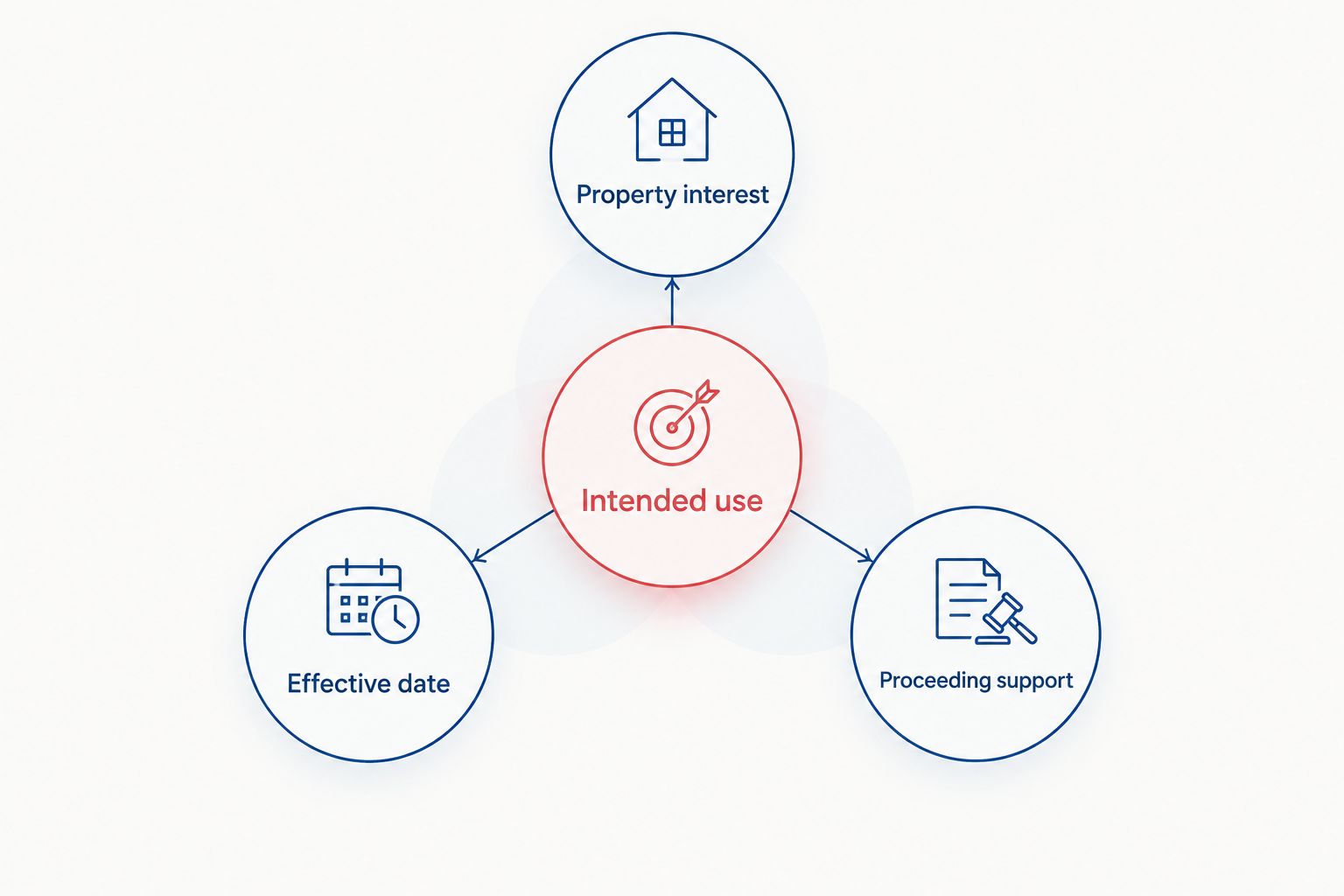
Use these 4 scope items:
- Property interest: Identify the parcel, ownership interest, occupancy, leases, and relevant restrictions.
- Effective date: State the required valuation date separately from the inspection date.
- Intended use: Specify the assessment challenge and the intended users of the report.
- Proceeding support: Identify whether counsel requires consultation, report preparation, rebuttal analysis, or testimony.
These details connect the property's facts to the work being commissioned. A generic request for a commercial appraisal leaves important decisions unresolved.
Keep 2 dates distinct: the effective valuation date and the inspection date. A property inspected in 2026 can require an opinion for another specified date; the analysis must address the relevant conditions and evidence for that effective date.
Ask which of the 3 recognized valuation approaches—sales comparison, income capitalization, and cost—the assignment requires. The appraiser should explain the relevance of each approach used and the reason for excluding an approach, rather than treating every method as mandatory for every property.
Discuss your New York appraisal scope
Clarify your commercial property’s valuation purpose, effective date, and required report scope.
How these options are ranked
The order follows the hiring decision: identify a suitable firm, match the valuation specialization to the property, and add proceeding experience when required. It is not a ranking of appeal results, report quality, or assessed-value reductions.
For your 2026 shortlist, evaluate every candidate against the same criteria: property expertise, local evidence, valuation date, interest appraised, reviewable reasoning, and proceeding fit. Reject a proposal that leaves a necessary part of the assignment undefined.
Do not ask an appraiser to promise a particular value or tax reduction. An independent opinion must follow the evidence, and the assessment outcome depends on more than the appraisal conclusion.
Which tax appeal appraiser should you choose?
Choose the appraiser whose written scope matches your property and your attorney's valuation requirements. For a rental building, prioritize income-property analysis. For an owner-occupied asset, examine comparable-sales competence. For a contested proceeding, require relevant testimony experience as well as valuation expertise.
Before signing, request a written description of deliverables, information requirements, intended users, and proceeding responsibilities. Confirm local filing dates separately; retaining an appraiser does not itself preserve an appeal right.
FAQ
What’s the best way to choose an ad valorem tax appeal appraiser in New York?
Choose an appraiser with relevant property experience and a written scope matching your assessment challenge. Confirm the effective valuation date, intended use, and required proceeding support before engagement.
Can a commercial real estate appraisal be used for a property tax appeal?
A commercial appraisal can support a property tax appeal when its scope addresses the applicable valuation question and submission requirements. A report prepared for lending or another purpose is not automatically suitable.
Is a tax appeal appraiser the same as a property tax attorney?
No. An appraiser develops a valuation opinion, while an attorney provides legal advice and representation. Define who is responsible for filing, procedural requirements, and presenting evidence.
Does the lowest appraised value make the strongest appeal?
No. A supported value conclusion is more useful than an unsupported low figure. The evidence, valuation basis, effective date, and reasoning must fit the assessment challenge.
What should I prepare before an appraisal consultation?
Prepare the assessment notice, property description, ownership and lease information, and any valuation instructions from counsel. For income-producing property, ask which financial records and supporting documents the appraiser requires.
Do I need an appraiser who can testify?
You need testimony capability when your proceeding requires appraisal evidence to be presented and defended. Ask counsel whether hearing preparation, rebuttal work, or an appearance belongs in the engagement.
Does the appraisal inspection date have to match the valuation date?
No. The inspection date and effective valuation date serve different purposes. The report must explain the relevant property conditions and support the opinion for the required effective date.
One last thing
A sale after the valuation date is not automatically irrelevant, and a sale before it is not automatically persuasive. The appraiser must consider what the transaction demonstrates about the relevant market and effective date, including any changed conditions.
Before commissioning your 2026 appraisal, ask one specific question: What evidence would change the value conclusion? The answer should identify facts and assumptions—not a promised assessment reduction.
Related guides
- Property tax appeal services for owners
- Commercial building appraisers in Manhattan
- Commercial property appraisers in Brooklyn
- Commercial land appraisal firms in New York