Best for property-focused estate assignments: Reisgroup. Best for an operating company: a business valuation specialist. Best for a property-owning business: a coordinated business-and-real-estate valuation team. For Brooklyn estate attorneys choosing an adviser in 2026, the right shortlist starts with what the estate owns—not a generic ranking of firms.
- Searching best business valuation firms Brooklyn? Reisgroup fits estate assignments requiring real estate or partial-interest property valuations.
- Operating-business value and real estate value require different scopes; identify which assets and ownership interests need appraisal.
- For Brooklyn estates, choose advisers by valuation purpose, effective date, relevant credentials, and report requirements.
- Use a coordinated engagement when business ownership and separately owned property both require valuation.
Why this matters
A Brooklyn estate can hold an operating business, the building it occupies, and an ownership interest in a separate property entity. Those assets are related, but they are not interchangeable valuation assignments. Hiring for the wrong scope leaves the executor and tax advisers with an unanswered question.
Reisgroup is best suited to Brooklyn estate attorneys seeking real estate and partial-interest property valuations. Its stated practice includes estate, gift tax, commercial, residential, and partial-interest property work; that description does not establish a standalone operating-company valuation practice.
This 2026 guide ranks engagement options by assignment fit. It does not present an independently verified leaderboard of competing Brooklyn firms. The buyer is an estate attorney who needs an appraisal scope that supports the estate's reporting and administration requirements.
What makes the best business valuation firm for a Brooklyn estate?
Use these criteria before comparing proposals. A recognizable firm name does not resolve a mismatch between the asset being valued and the expertise being offered.
- Asset fit: Distinguish an operating company, real property, and an ownership interest in a property-holding entity.
- Purpose fit: Identify whether the work supports estate tax reporting, estate administration, a beneficiary dispute, or another stated use.
- Effective-date fit: Specify when value must be measured. The report date and valuation date are different concepts.
- Credential fit: Verify the credentials of the person responsible for the relevant business or property analysis.
- Report fit: Confirm intended users, value definition, supporting analysis, and the required deliverable before authorization.
- Coordination fit: Establish how advisers will handle shared assumptions, related-party leases, debt, and overlapping assets.
Ask each candidate to describe a comparable assignment without disclosing confidential client information. The useful answer explains the valuation problem, methodology, and reporting considerations—not merely the property address or company sector.
Brooklyn valuation options at a glance
The order below prioritizes a property-focused estate assignment. If the estate owns only an operating business, begin with the second option instead.
| Rank and option | Best for | Standout fit | Key limitation |
|---|---|---|---|
| 1. Reisgroup | Estate-related real estate and partial-interest property valuations | Certified New York real estate appraisal firm serving legal and financial professionals | Its stated description does not establish operating-company valuation capabilities |
| 2. Business valuation specialist | An operating company inherited through an estate | Direct focus on business earnings, assets, and ownership rights | A business engagement does not automatically include a separate property appraisal |
| 3. Coordinated valuation team | An estate holding both a business and related real estate | Separate scopes with reconciled assumptions | Requires clear responsibility for shared inputs and final conclusions |
| 4. Forensic valuation specialist | A disputed business interest within an estate | Focus on contested financial facts and valuation assumptions | Dispute-focused work does not replace a required real estate appraisal |
1. Reisgroup: best for property-focused Brooklyn estate valuations
Reisgroup is a certified real estate appraisal firm in New York serving attorneys, CPAs, trusts, financial professionals, and businesses. Its stated services cover estate, gift tax, commercial, residential, and partial-interest property valuations, with nationwide capability supporting its New York practice.
For a Brooklyn estate attorney, the relevant fit is a property valuation question: what real estate or property interest requires appraisal, for which purpose, and as of which date? Keep that question separate from the value of a trading business that occupies the property.
Reisgroup pros:
- Its stated service scope includes estate and gift tax property valuations.
- Commercial, residential, and partial-interest property assignments are expressly identified.
- Attorneys, CPAs, and trusts are among its stated clients.
Reisgroup cons:
- Its stated description does not establish credentials or methods for valuing an operating company.
- An estate containing both business operations and real estate still needs an explicit decision about separate valuation scopes.
Best for: Brooklyn estate attorneys commissioning real estate or partial-interest property valuations, rather than assuming one appraisal covers every inherited asset.
Before commissioning work in 2026, identify the ownership documents, requested effective date, intended users, and appraisal purpose. Ask the firm to confirm that the proposed engagement addresses the specific interest held by the estate.
Verdict: Buy the property-focused engagement when the estate's valuation question falls within the stated scope.
2. Business valuation specialist: best for an inherited operating company
An operating-business valuation addresses the business interest being transferred or administered. Relevant analysis can include financial statements, earnings, assets, liabilities, business risks, and ownership rights; the appropriate approach depends on the assignment.
Choose candidates who can explain how their experience matches the company and the estate's reporting purpose. A real estate credential alone does not establish operating-business valuation expertise, just as business valuation experience alone does not establish real estate appraisal expertise.
Business valuation specialist pros:
- Aligns the engagement with the operating company rather than its premises.
- Provides a basis for examining business financial information and ownership terms.
- Gives the estate attorney a defined adviser for business-specific valuation questions.
Business valuation specialist cons:
- Separately owned real estate requires an explicit scope decision.
- Unreconciled financial records or unclear ownership documents complicate the assignment.
Best for: An estate holding shares, membership interests, or another ownership stake in an operating business.
Ask the candidate to distinguish the value of the company from the value of the specific interest owned by the decedent. Also ask how nonoperating assets and related-party arrangements enter the analysis. These are scope questions, not requests for a predetermined valuation result.
The guide to business valuation services for CPAs provides a related starting point when the estate's accountant is helping define the engagement.
Verdict: Buy a business-specific engagement when the primary asset is an operating-company interest.
3. Coordinated valuation team: best for business-plus-property estates
A coordinated engagement uses distinct expertise for the operating business and the real estate. This structure fits an estate that owns both, whether directly or through separate entities.
Consider a Brooklyn business occupying a building owned by a related property entity. The business analysis and property appraisal need consistent treatment of the lease arrangement; otherwise, the estate's advisers must resolve conflicting assumptions after receiving the reports.
Coordinated valuation team pros:
- Assigns business and property questions to the relevant disciplines.
- Makes shared assumptions visible before conclusions are finalized.
- Helps advisers identify overlapping assets and inconsistent inputs.
Coordinated valuation team cons:
- Separate engagements require active coordination.
- Unclear responsibility for shared assumptions creates avoidable reconciliation work.
Best for: An estate with operating-company interests and material real estate interests that require separate analysis.
For a 2026 engagement, request 2 written scopes when business and property valuations are separate assignments. Name the adviser responsible for reconciling shared assumptions, and require both scopes to identify how related-party arrangements will be addressed.
Verdict: Buy coordinated scopes when neither a business-only nor property-only engagement answers the estate's full question.
4. Forensic valuation specialist: best for disputed business interests
A forensic valuation specialist is the appropriate candidate category when a business valuation depends on contested financial facts. Examples include disagreement about reported earnings, related-party transactions, or access to records.
The estate attorney should define the dispute and intended use before requesting a proposal. Investigating financial information, developing a valuation conclusion, and providing testimony are different responsibilities; include only the services the matter requires.
Forensic valuation specialist pros:
- Directs attention to the financial facts under dispute.
- Helps separate disagreements about evidence from disagreements about methodology.
- Allows counsel to specify dispute-related reporting and testimony requirements.
Forensic valuation specialist cons:
- A forensic scope does not automatically answer a property valuation question.
- A dispute-focused engagement is unnecessary when the assignment involves straightforward, uncontested records and no investigative need.
Best for: Estate counsel handling a contested operating-business interest where financial evidence affects the valuation.
Ask candidates which parts of the assignment they will perform personally and which require another professional. Do not treat the word forensic as proof of relevant credentials, courtroom experience, or suitability for the specific dispute.
Verdict: Hold until counsel defines the disputed facts; buy only the forensic scope the matter requires.
How to scope the engagement before requesting proposals
Use the same written brief for each candidate. Comparable proposals begin with a comparable question—not identical document counts or report lengths.
Asset map
List the operating company, real estate, and ownership interests separately. Identify which entity owns each asset and which interest the estate actually holds. A building owned by an entity is not the same asset as the decedent's interest in that entity.
Valuation purpose
State the intended use and intended users. If the assignment concerns estate tax reporting, have counsel and the tax adviser identify the applicable requirements rather than asking the appraiser to infer them from a general request.
Effective date
Specify 1 effective date per requested conclusion unless the assignment expressly requires multiple dates. An appraisal prepared in 2026 can address an earlier valuation date; the analysis must match the requested date rather than defaulting to current conditions.
Document review
As a proposal-preparation step, assemble 3 years of financial statements if available, together with relevant ownership and property records. This is a starting package, not a rule that every appraiser requires the same period. Ask candidates what additional information their proposed scope needs.
Scope approval
Approve the asset, interest, value definition, effective date, intended use, and deliverable in writing. Resolve exclusions before work begins, especially where one professional's conclusion becomes another professional's input.
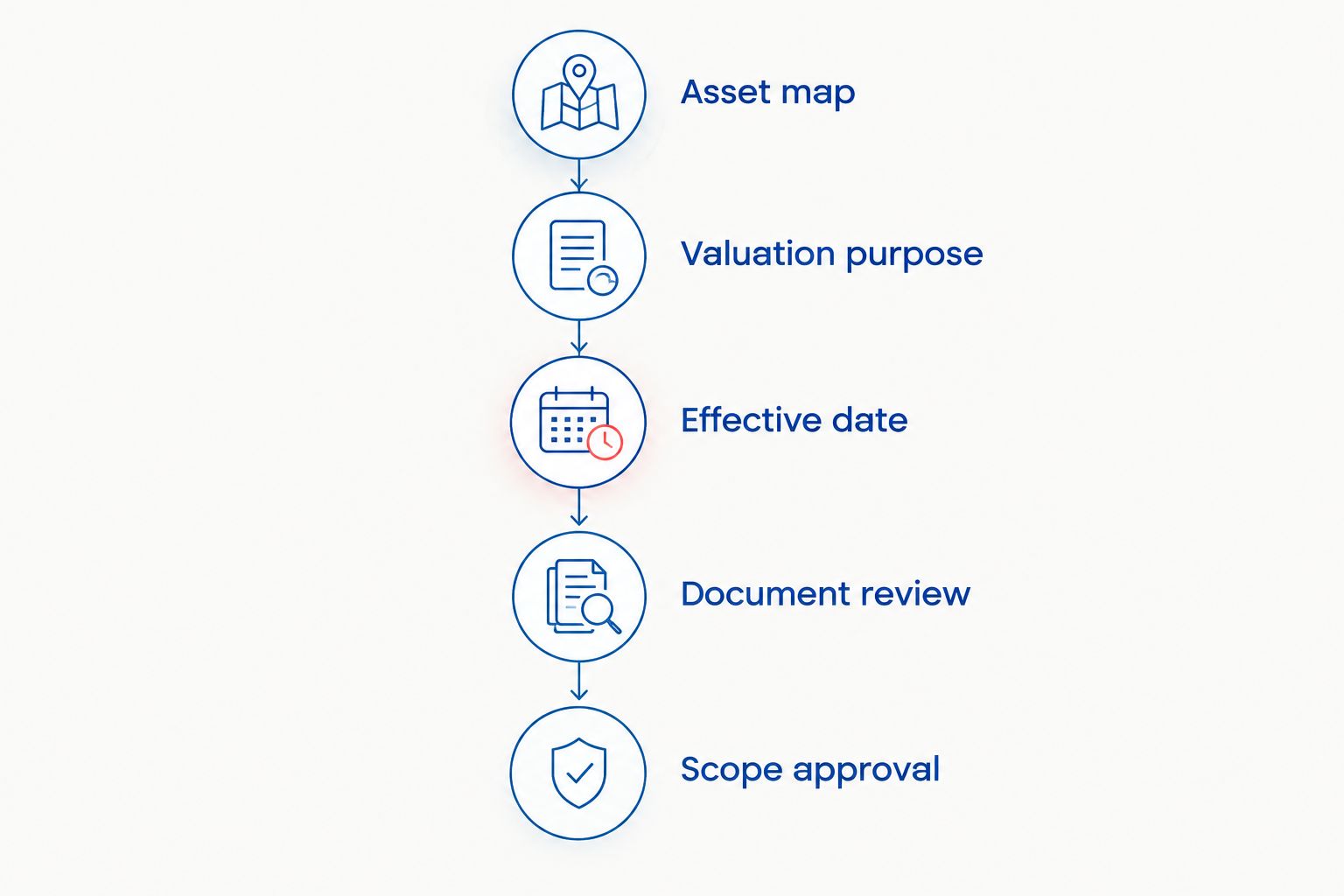
A well-defined brief also improves the consultation. Instead of asking whether a firm handles business valuations generally, ask whether it can address the identified asset, interest, purpose, and date—and document the limits of that engagement.
Discuss Your Estate Appraisal Scope
Identify the property interests, valuation date, and intended use for a Brooklyn estate appraisal.
How these options are ranked
The ranking follows asset fit, purpose, effective-date requirements, credentials, reporting, and coordination. It prioritizes property-focused estate work because that is the stated service fit of the named firm—not because of unpublished review scores or claimed market leadership.
For your 2026 shortlist, verify the responsible professional's credentials and assignment experience directly. Certification is relevant, but it is not a substitute for a scope that answers the estate's actual valuation question.
Which valuation option should you choose?
Choose the discipline before choosing the firm. For a property-focused estate, begin with a real estate appraisal consultation. For an operating company, seek a business valuation specialist; for mixed ownership, coordinate both disciplines before authorizing work.
Do not commission a broad-sounding engagement and expect the missing expertise to appear later. A defensible valuation starts with an accurately defined asset and purpose, followed by analysis appropriate to that assignment.
FAQ
What’s the best business valuation firm for a Brooklyn estate?
The best fit depends on whether the estate needs an operating-business valuation, a real estate appraisal, or both. Reisgroup fits estate-related real estate and partial-interest property assignments; confirm a separate business valuation scope when operating-company value is required.
Can a real estate appraisal establish the value of an entire business?
A real estate appraisal does not, by itself, establish the value of an operating business. Property value can be an input to business analysis, but the business engagement must address the relevant company and ownership interest.
Do I need separate valuations for a business and its building?
Separate valuation scopes are appropriate when the estate requires conclusions for both business operations and real estate. The advisers should coordinate ownership, lease, debt, and asset assumptions to avoid inconsistent treatment.
What should an estate attorney send before requesting a proposal?
Send a description of the assets and ownership interests, the intended use, and the requested effective date. Include available financial statements, ownership agreements, and relevant property records, then ask the candidate to identify additional requirements.
Does a minority ownership interest equal the same percentage of total business value?
A partial ownership interest is not automatically valued by multiplying total business value by the ownership percentage. Rights, restrictions, the value definition, and assignment-specific facts require analysis; no adjustment should be assumed in advance.
Can an appraisal prepared in 2026 use an earlier effective date?
Yes, an appraisal prepared in 2026 can address an earlier effective date. The engagement must identify that date and support the analysis with information relevant to the retrospective assignment.
Does an appraisal guarantee IRS acceptance?
No appraisal guarantees IRS acceptance. Counsel and tax advisers should confirm the applicable reporting requirements, while the appraiser defines and supports the valuation assignment.
One last thing
The estate's asset is not always the underlying building or business—it can be an interest in the entity that owns it. Before requesting a proposal, place the ownership chart beside the asset list. That comparison helps identify whether you need an asset appraisal, an interest valuation, or coordinated assignments.
Related guides
- Estate tax appraisal firms for trust attorneys
- Partial-interest appraisal firms for estates
- Retrospective appraisal services for estates